dime_novel_hero: 2018-present (Default)
On my second range day with my new cyberpunk SARB-15 bullpup rifle, I realized a major flaw in my first outing in that I was attempting to sight my rifle optics with a red dot and reticle on a target with a red diamond at its center. This time, I switched to a green dot and that contract, plus a more stable sandbag setup, reduced my groups by about half. My six inch groups at 50 yards became three inch groups. Roughly.

But I was still unhappy with what I was seeing. I wanted some magnification to see the target better. The recommendation is to buy the scope for 80% of your shooting and the Vortex Optics Spitfire 1x Prism Scope was that, but switching out the range to 100 yards, I was having difficulty and could only imagine reaching out beyond that. I would not want to completely tank any shots out beyond 100 yards because my scope (and eyes) were only capable for that inner 80%.

Thus, I ordered a Monstrum Ghost G3 3X Micro Magnifier with Flip-to-Side Mount. They are supposedly designed to either sit in front of or behind the prisim optic to provide that magnification when you need it and flip out of the way when you don’t.

The third range day did not go well.

I tried the new magnifier after the prism optic and simply could not get it to work well. I think the second optic was adding a distortion so that I should, theoretically, sight it in through the magnifier but, once I moved it out of the way, the reticle wouldn’t line up anymore. I moved both optics so that the magnifier came first and it simply would not focus. The reticle was always either blurry or refracted. I moved back to the initial setup and, in the second attempt, could not make it work.

I returned the magnifier.

At the Liberal Gun Club annual convention, I had a chance to look through a Vortex Optics Spitfire 3x Prism Scope and I liked it. That was much of the reason I chose to get the Vortex 1x model. With that, I was looking at mid-ranges and though that, even at close range, the 3x wouldn’t be bad. So, I got one of those and put my 1x in a box for some future gun (perhaps a Ruger 10/22).

The fourth range day didn’t start out well. Sure, after mounting the scope I had used a laser bore sight at my workbench to try to line things up but the first shots at range went . . . somewhere. Not through the board. With the bore sight and the ballistics of the 5.56 NATO, I should have been off by a hand-span. Maybe even two. Who knows where those first rounds went.

I had brought my laser with me so went off the line to try to line things up again.

The next 5 round just barely hit the board, mostly centered but 22 inches high, but that was something I could work with. Adjusted, I pulled it down to 13 inches high. Then 5 inches high. Then just a little over half an inch low and a quarter inch to the left.

Nice.

According to the published ballistics and my optics setup, if I want to be zeroed at 100 yards (the reticle is calibrated for that) I should be an inch and three quarters low at 50 yards. I made some adjustments to try to get that and then took the rifle over to the 100 yard range and found it was printing about 2 inches high. I’ll do more math to try to work that discrepancy out but I may be better served by more testing at various ranges to work out the rifle’s actual performance.


This trip was about the 3x optic, though, and I was pleased. I could see at 50 yards very well and I wasn’t straining to see an 8 inch bullseye at 100 yards. And, also important, my group sizes had improved over what I had been doing with the 1x optic. My best groups were one inch at 50 yards and two inches at 100 yards (off the sandbag). Though most of my groups were bigger than that, they were still consistently half what I had been doing the week before.

When I was young and my eyes were good, I would spend my entire day and allowance at the Boy Scout summer camp rifle range. “One MOA all day long” with my grandfather’s Winchester Model 67. In the intervening four decades, however, I have not maintained that. Standard mil-spec expectation of the AR-15 is 4 MOA. That is (roughly) a four inch group at 100 yards. I am doing a little better than that but I am still far from the performance of my youth.

But also, the kind of shooting I am preparing for is different from the shooting I did then. Once I get the gun zeroed where I want it to be and am confidant in the machine’s performance, I am going to expand my manual of arms. Standing, kneeling, prone. Different ranges. Tactical movement. The Cabin Fever Challenge and Brutality-CQB East are going to be my benchmarks. I can make a two inch group off a sandbag at 100 yards, what if I was standing? Kneeling? After having just thrown a 35 pound kettle bell and run to where it landed?

That’s on me.


dime_novel_hero: 2018-present (Default)
I was able to get my bullpup project out to the range this past weekend to break it in. Foxtrot Mike, the manufacturer of my upper, recommends 500 rounds to break in their rifles. I was only able to get about half that much shooting done in one sitting and I will be able to do as much next weekend (after I buy some more ammo) but it was a good start.

“Remember kids, the only difference between screwing around and science is writing it down”

I did write down quite a bit but I wouldn’t exactly call it science. I took notes and did some math. I won’t be sharing all those details here but I will share some of the highlights and what I have learned about this new platform. Bullet points, if you will.

The first is a ME thing. With one set of shooting glasses (sunglasses, side-shields, newest prescription) I don’t think I had the clearest image. That, and my lenses were fogging up. I swapped to a second pair of glassed (amber wrap around lenses, 2 year old prescription). They didn’t fog but I can say they were much better. In the end, I shot with my regular, daily wear, outside prescriptions. They afforded me the best view even though they were not my newest prescription.

My grandfather was a trophy-winning trap shooter and he would have his optometrist set his prescription focus to 30 or 35 yards. I don’t think I will go as far as that but I may need to get better glasses.

I need to add a microfiber lens cleaning cloth to my range bag.

It is recommended that one get a scope for the 80% of shooting that they do. If one is going to be doing most of that shooting at ranges of under 100 yards there isn’t much call for magnification, which is why I have a 1x prism. But, getting back to that glasses thing, looking out to 100 yards is a challenge for my aging eyes. Reaching out further than that will be even worse, even if only a rare occurrence. I have decided that I will get a magnifier (probably a 3x) and set it (probably) in front of my prism rather than getting a dedicated magnified optic. Firstly, it will be cheaper to do it that way since I’ve already bought the one optic. Also, the magnifier can be flipped out of the way when I don’t need it for the close stuff.

I need to add some extra batteries to my range bag.

When I was shooting 50 yards at first to sight in the scope, I used sight in targets with a red diamond and a 1 inch black grid. When I moved out to 100 yards, I also switched over to 8 inch black bullseye targets and my sight picture improved dramatically because (duh) I had been trying to sight a red dot scope on a red dot target. Only with that realization did I remember that my prism scope also has a green dot. That would have made my attempts to sight in the scope so much easier.

At the start, the bolt would not stay back as it should on the last round of a magazine. By the end, though, the recoil spring had broken in enough that the bolt was locking back on the last round.

Getting the “Paratrooper” charging handle was a wise decision. Especially when, early on, the bolt wasn’t staying back on the last round so I was racking the bolt a lot. Was a bit tough on the hands but it would have been more unpleasant without the larger handle. It has me wondering if, in competition, I might want gloves.

I moved the cheek riser forward a little. My face doesn’t rest where it is most comfortable but having it back as far as it was ended up hitting my ear muffs.

I shot both 223 Remington and 5.56 NATO rounds. I am told that, because the 5.56 ammo is more popular, it tends to be less expensive but the ammo I bought was the same price for either. I am also told that the 223 ammo, with its lower chamber pressures, tends to be more accurate. My shooting experience didn’t reveal a significant difference.

The 223 Remington smelled differently from the 5.56 NATO.

Out of about 250 round I had three feed jams. These jams left significant dimples in the brass. Online research returned, of course, a variety of diagnoses. One was that it was “definitely” the magazine. I have two mags and two of those jams happened on the same 5-round mag string. The third happened on the other mag later in the session. With only those, I don’t think it was the mag. Nor do I think it was the ammunition, two happened with the 5.56 NATO rounds and one with the 223 Remington ammo.

Another online suggestion was that the gas blowback wasn’t pushing the bolt back far enough. “Could also be under-gassed or over-gassed. I had this same issue and after going through the magazine spring, buffer spring, and buffer weight I found that my gas block was off centered so the gas flow was disrupted. The blowback didn't push the bolt back far enough to chamber another round “

This looks like my answer as, I have already noted, the bolt wasn’t coming back far enough to lock open on the last round of the magazine so, in my case, the issue was the buffer spring. Again, by the end of the session it had loosened up enough that it was locking back consistently so I’m expecting that will also end the jamming issue.


“The Rifleman is a person capable of hitting 20 inch targets from 500 meters with standard, rack grade equipment and ammunition.”

That means that one should be printing 4 inch groups at 100 yards or 2 inch groups at 50 yards. For consistency, call it 3.5 Minutes of Angle. An M16/M4/typicalAR shoots between 2 and 3 MOA. NRA competitions have a “clean” group at 200 yards of under 3 MOA. From varying sources and conversions, the Marines expect to qualify with a 4 MOA standard.

I am not that guy.

My groups at 100 yard were “on the paper” but that was only because I was shooting from a sandbag. Good enough for Brutality CQB where you are shooting at man-sized steel plates but certainly not “rifleman.” The Cabin Fever Challenge is generous with an 8 in target at 100 meters or 7 MOA but has one shooting standing, kneeling, prone, and sitting. Shooting offhand, my grouping would be even worse. But that’s part of the point of this whole endeavor, isn’t it. To do more shooting so that I can become a better shot.

My father, my grandfather, even my grandmother, were naturals. I need to work at it. I have a day off this week so I may be able to go to the range but that will likely be an introduction to the bullpup for my partner. Once the weekend comes around again I will be again out to the ranger to properly put a another few hundred rounds through it.
dime_novel_hero: 2018-present (Default)
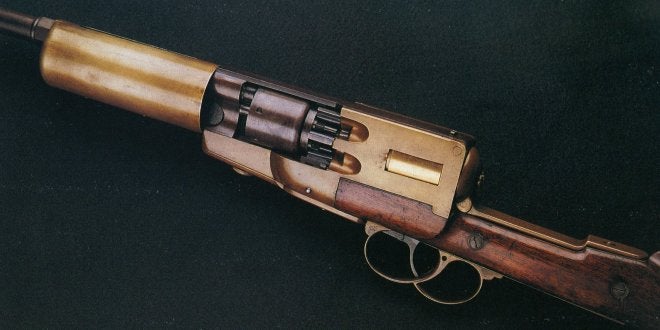
The first bullpup firearm (that we know of) was heavy bench-rest target rifle manufactured around 1860 in London for a Professor Richard Potter. In 1866, William Joseph Curtis patented a repeating rifle design that sat on top of the shoulder. He also described using exhaust gas to cycle the action. There was the Thorneycroft carbine of 1901 and the French Faucon-Meunier semi-automatic rifle of 1918.

Technically then, bullpup qualifies as steampunk, even though the term didn’t come into use to describe firearms with the trigger in front of the breech until the 1930s.

And so my movement into the world of the AR platform began with the requirement that it also be bullpup. Steampunk to cyberpunk. I also decided on obtaining a kit rather than a design built model because I wanted the flexibility on non-proprietary parts and the ability to return to the conventional build should I so choose.

Procurement

I settled on the SARB-15 from SRU Precision mostly for aesthetic reasons. Of the number of kits available, this was the one that I thought looked the best. Originally designed for airsoft, I think aesthetics was top of their design concept as well. It also turned out to be highly rated for fit and quality. I emailed the manufacturer with a question about tariffs and shipping and they immediately responded indicating there would be no issues. It took less than a week for my kit to ship from Taiwan.

The kit has some specific requirements to make bullpup work; specifically a bufferless upper and a mil-spec lower. There was a recent gun show locally that I went to looking for, perhaps, just what I would need there but all the offerings were the traditional setup. I also hit a number of local gun shops. One knew nothing about kits and also had nothing with a bufferless upper. They might have sold me a used Springfield Hellion bullpup for $1,200 but what they really pushed for was the traditional platform.

Shopping online, I settled in on a Palmetto State Armory mil-spec lower on sale and a Foxtrot Mike bufferless upper. I tried an online chat with PSA to see if they had a lower cost upper that would meet my requirements but their chat bot was incapable of even remotely answering my question or even put me in touch with an actual human. I attempted the same thing with their online messaging and also through email but never received any response. Minus three points for customer service. Even so, I wasn’t able to find something better somewhere else so I ordered from PSA.

That went bad right off as the order for the lower completed but the upper was rejected. I tried several times and with different cards to no avail. I tried calling PSA but their phone system took a voicemail for which I never got a callback. I tried their chat and emails again but also never got a response. Minus more points.

What had happened, near as I can tell, was that my bank had seen the purchase and suspected a fraudulent use of my card. Once that happened, PSA also locked the order so I couldn’t complete the order, even with another card. I got a call from my bank asking about the purchase and I confirmed that, yes, I authorized that purchase. I was able to try again with PSA the next day and have the order complete, again, having never gotten a callback from PSA. Minus more points from PSA and my bank’s customer service. I have never had my bank actually protect me from an actual fraudulent purchase, they have only ever prevented me from spending my own money.

The upper arrived in less that a week. The lower took nearly two.

I ordered a Vortex Spitfire Prism Scope off of Amazon. I had the opportunity to try the 3x version at the LGC Convention a month back and the prism solved the slight astigmatism issues I have with red dots. The recommendation is that you choose the sight for the 80% of shooting you do and so I decided on the 1x version of the scope. If I need more magnification to reach out beyond 100 yards I will get a second magnifier to sit in front of the prism that I can flip out of the way when I don’t need it.

I bought some ammo. The Foxtrot Mike upper is chambered in 223 Wylde, which is designed to be able to handle both .223 Remington and 5.56×45mm NATO. I bought some of both because, while the 223 has lower chamber pressures and is more accurate, the NATO standard tends to be cheaper. I will want to know how each behaves under varying circumstances.

I ordered a Hera Arms CQR Foregrip because it makes the whole package look more like Major Kusanagi’s Seburo C-26A from “Ghost in the Shell.”

I bought a 2-point sling because that is something I will need eventually.

I bought a couple of Magpul magazines.

Assembly

Unexpectedly, putting it all together went almost entirely according to plan. Fit and finish of all the parts; the upper, lower, and the kit, made the whole step-by-step process just a matter of the time it took to do. Like building Lego.


I said “almost entirely.”

Adjustment

The scope sat too low. On the traditional AR-15, the scope sits on top of a carry handle and I had failed to take that into account. I had to order a picatinny riser mount to raise the scope up an inch.

I didn't like the size of the charging handle so I ordered a larger folding “Paratrooper” handle from Foxtrot Mike. That needs an extra long 3/32” hex key to swap out. I tool that I do not have. I needed to order on of those.

The foregrip needed to attach to a lower picatinny rail and the front shroud for the SARB-15 is built for M-Lok mounts, and so I needed to order that.

All told, these required add-ons almost two weeks to the project, the scope mount being the one that functionally kept me from getting out to the range. The recommended break-in is 200 rounds in one sitting and, if I was going to do that much shooting I would need to have an optic rather than just randomly throwing lead down range.

But once all those parts came in, they went on and the construction was complete.

While I am chaffing at the bit to get out to the range and put it through its paces, the onset of Daylight Savings Time (just because it was Ben Franklin’s idea, doesn’t mean it was a good one) means that there isn’t enough daylight after work to be productive that the range.

That means the weekend.


dime_novel_hero: 2018-present (Default)
This past weekend was the Liberal Gun Club’s annual convention, this year on the east cost at a club almost just over the hill from me. Even so, it almost wasn’t a thing because our current fascist-wannabe administration declared pretty much every organization left of Ronald Reagan to be “nihilist violent terrorists”, putting the LGC literally in the cross-hairs of MAGAt fuckwits ready to turn out to do the government’s stochastic bidding. Near as I can tell, nearly half the people who were going to attend decided not to because of that very real threat.

I decided the risk, while real, was very low and, on top of that, we were all well armed, and the gravy seals and cosplaytriots have shown themselves time and again to be inept cowards, retreating into their rented vans to flee at the slightest sign of actual resistance. Guys that can be chased off by people wielding words and cell phones are not going turn out to challenge a gun club.

For myself, I brought six guns for range day. My 45 lever gun was popular. My M1887 lever shotgun was more popular. In Cowboy Action Shooting, I had only ever used #7 bird shot target loads to knockdown steel plate at maybe 7 yards, but here I was able to cycle full power 1oz and 1.25oz rifled slugs. Ooof! That’s spicy! What I didn’t have a chance to do with it is to see how far I could reach out accurately with it. 50 yards? 100 yards? My guess is that, for a full sized target, 75 yards is going to be my 50/50 range. Maybe less. But I shot up all my slug rounds so I’ll have to buy more to test that hypothesis.

I did not attend any of the classes that were available (they cost more money) but the Old Guns class took place right next to the open range I was at, allowing me to look over shoulders at the assortment. The presenter had everything blackpowder from a handgonne up to cartridge guns (with, I think, the exception of a wheel lock). No one wanted to shoot the 75 cal matchlock, maybe they were intimidated by the caliber, so I stepped up to give it a go. Unlike many other guns that have a trigger sear and a spring where, once you put enough pressure on the trigger it fires (click, bang), this has a lever which, as you pull the lever moves the lit cord closer to the priming pan. I made the mistake of treating it like a trigger and I think doing that mashed the cord such that it didn’t ignite the powder. I had to try a couple of times more gently. The recoil wasn’t so bad. Yes, the big projectile means more recoil but blackpowder burns slower and with less pressure so the recoil impulse is more of a shove than a punch. Probably no worse than my Martini-Henry.

My near-term gun plans involve selling a few guns and using those funds to buy a budget AR platform and drop it into an SARB-15 bullpup kit. To that end, I took my M1 Garand to a shop to see what I could get for it.

The answer was nothing.

The guy at the shop said that the barrel was pretty much shot out so he wouldn’t buy it or trade it in. The gun was manufactured in 1940, was refurbished an 1953, and subsequently had its barrel shot out before I bought it in the 90s because, in that 30 years I certainly never shot it enough to wear out the barrel. Even so, he said the gun was in otherwise very good condition. I asked, if he was going to sell it, informing the buyer that they would need to replace the barrel, what he thought it was worth. He said $1,000.

I took it with me and found someone who was interested in it, knowing that it would need re-barreled. The challenge will be getting it to her because she lives in Massachusetts and would not have been able to purchase it and take it home with her on the plane.

Once that is all sorted out, she’s still going to get a good deal as I am throwing in a bunch of clips, some manuals, cleaning rod, assembly mat, and a bayonet.

I got a chance to shoot a number of ARs in various configurations but no one had anything bullpup. More important than the shooting part, though, was the ability to try a number of different optics. I had a red-dot sight of my own and inherited another from my father and I experienced an issue with flaring on both of them. Though undiagnosed by my optometrist and not recognizable by me under most conditions, I must have a slight astigmatism that manifests itself by showing me a small starburst rather than a nice small dot in a laser sight. I ended up taking the red-dot off my dad’s Ruger MkII and replace them with a more traditional three-dot fiber optic.

I got a chance to look through several versions of a holographic sight. That was a clean glowing reticle that showed no sign of the flaring I experienced with the laser.

Then I looked through a Vortex Spitfire. This one uses a reticle engraved into a prism. It was also a very crisp image with the added advantage of, if the light is turned off, the engraved reticle is still visible like the traditional crosshair reticles. I liked that a lot and put one on my Amazon wishlist. I probably won’t get that exact model because I will ultimately want to have some magnification to occasionally reach out to longer distances and will need some magnification. Maybe something adjustable 3x to 5x. Magnification ramps up the cost.

Saw some neat flip-up “iron” sights that sat at a 45 degree angle so, for the close shots, you would just rotate the gun a bit instead of having the scope blocking your view.

Someone told me that bullpups are a “money pit” but, honestly, all these “add-ons” would end up on the gun whether it was bullpup or not.

Back in 1985, I got my rifle/pistol/shotgun/self defense training certification from the NRA. (Fuck them). I didn’t put it to much user after a while and so let it lapse. The LGC offers a certification and I am thinking I should pick that up again.

As with my experience with Brutality Matches, I find that these are my people. They are diverse. Intelligent. Thoughtful. Welcoming. Empathic. Encouraging. Sharing. All the things good humans are.
dime_novel_hero: 2018-present (Default)
First off, I want to say that, even though I have been posting a lot about shooting sports recently, this is still not a gun blog. It’s supposed to be steampunk. It’s just that the late unpleasantness has kept me out of the public, and steampunk festivals and comic conventions are so very public. So many disease-ridden monkeys. The shooting sports, however, occur in an environment that has fewer people at any one time and are almost entirely out of doors, lowing the COVID risk to the point of my participation.

So, the steampunk I do tends to also involve guns.

This may become more relevant later.

“The first rule of gun safety is to have fun.”

It’s actually not, but it also is. As Obi-wan said, "From a certain point of view."

Enjoyment increases engagement. If you are not engaged, you can more easily become complacent and distracted which leads to negligence. A negligent discharge means the a whole lot of people aren’t having fun anymore.

I have experienced this. Thankfully not the “shooting someone” part but the “engagement is attentiveness” part. In Cowboy Action Shooting, each stage is pretty much the same. Ten rounds pistol, ten rounds rifle, two or maybe 4 shotgun. The order is mix or match, the targets vary a little, but it’s all very routine. Many shooters take this very seriously and focus very intently on shooting as quickly as possible and that intensity is, I don’t want to say infectious, but you can certainly feel the air of intensity that, honestly, doesn’t feel like they are having fun. Subsequently, I do note a significant number of safety warnings. When moving right to left, I have been warned numerous times about the possibility of sweeping the spectators with my shotgun barrel. Never DQ’d, but there have been warnings.

On the other hand, having attended several Brutality matches, each stage is very different. A lot more variation in the target sizes, the ranges, the movement between them. Additionally, the participants are clearly having a lot more fun. They are more invested in their cosplay. They seem less invested in the perfect run. They laugh more. There is more comradery. More encouragement. I would characterize it as not jut fun, but joyful. And, from that, I don’t recall a single safety warning being issued. I ran stages much more attentively. More safely.

The point of this post, though, is not so much about safety but about increasing the fun. Hobbies are supposed to be fun and I want this hobby of mine to be more fun. Really, we could all use more fun at this point.

One way to have more fun in the shooting sports is simply to do more shooting. I have done more shooting this past year after having discovered Brutality Matches and the Cabin Fever Challenge than at any time in my life, even counting that summer I was a rifle instructor and when I was at Boy Scout summer camp at the rifle range with all my free time. My partner has a job repainting murals on a castle wall on periodic weekends and, after I have driven her to that I traverse to a nearby State Game Lands and have been availing myself of their facilities. My skills have improved, and that makes it more fun.

But it is also expensive. My chosen primary guns are cowboy guns in 45 Colt. When I started, a box of 50 round of that cartridge was $27. A box now costs at least $50 and as high $70 a box. A simple range day can cost hundreds of dollars.

Not so much fun.

It’s ironic that the way for me to save money shooting more is to spend even more money to buy more guns. I have a Heritage Rough Rider, something of a copy of my Single Action Army pistols but in 22LR rather than 45LC. Ten cents a round compared to over a dollar a round.

But to do something similar with my lever gun, Henry has a 22LR lever gun for $370. With the different sight picture, I’m not sure practicing with that would benefit me as much a doing dry fire exercises with my Rossi 92. Dry fire costs zero money, which is good, but dry fire isn’t as fun as live fire.

One of the other considerations was to just simply add a new gun to shoot. Influenced by the YouTube channel BrittishMuzzleloaders, I was considering getting the bolt action Lee-Enfield. I already have a Martini-Henry and so getting the period successor Lee-Medford would keep me in the steampunk realm, or rather, getting the successor to the successor that is the Lee-Enfield would be period adjacent. I think such a rifle would be more fun to shoot than the M-1 Garand I have now filling the battle rifle role.

Except, that getting ammo for such a thing ($1.50/rnd) is even more than what I am paying for either my 45 ($1+/rnd) or the Garand ($1.50/rnd). Well at least it’s still cheaper than the Martini-Henry ($5/rnd).

Remember how I said “shooting more is more fun?” Well, to shoot more it needs to be more affordable. I need to use a cheaper ammunition and one of the most popular, thus most plentiful, thus cheapest ammunition available is .223 (5.56×45mm NATO). A quick search finds ammo for 45 cents a round and buying in bulk (something I have found very difficult to do for 45 ammo) can bring that down to 34 cents a round. That buys me three times as much shooting

And the most popular, thus most plentiful, thus cheapest platform for that ammunition is the AR-15 and its gazillion variants. There are over 20 million AR-15s in the United States (I’ve seen estimates over twice that) and, the way I hear it, the market has bubbled and may be beginning to collapse, driving the cost down. For the return I could get selling off my M-1 Garand, I could finance an AR-15 platform that is almost half as expensive to shoot.

But it’s not period.

It’s not that I have anything against modern firearms, I just find those of the 19th Century more interesting. It was a time of tremendous innovation and development. The half century between the time of muzzleloaders, which had been the state of the art for 300 years, and the foundations of nearly all modern designs. I am in steampunk after all and it was being in steampunk and seeing a Single Action Army on a table at a gun show for an amount of money I currently had in my pocket that started my Cowboy Action Shooting career, as it were.

How then to reconcile my 19th Century sensibilities with the economic drives of the 21st Century?

Cyberpunk.

I grew up when cyberpunk as a literary genre was being born. Sure, I was still reading Welles and Verne, and steampunk was also growing with Jeter, Blalock, and Harrison, but I picked up “The Difference Engine” by William Gibson and Bruce Sterling and easily shifted over to “Neuromancer.” I was playing “Space 1889” and “Cyberpunk 2020.”

And if there is one thing that Cyberpunk books, games, and movies could all agree on about the future of firearms technology, it was that bullpup was going to be the future. And it is not a coincidence that Brutality Matches has added a Steampunk division that requires bullpup rifles.

So, as I get closer to an actual decision, I move away from emotional responses that might lead to a Lee-Enfield impulse buy, into research and analysis. I think I have only one time fired an AR-15 and so need to make sure I know what is what if I am to spend a bunch of money.

And what is a fuck-ton of money is a bullpup. Design built bullpups tend to start at $2,000 and go up from there, though I was able to stop in to a gun shop the other day and they had a used Springfield Hellion for only $1,250. I didn’t dislike it but I thought it a bit heavy. Especially compared to the SIG-built AR-15 they also handed me. That gun was also over the $1,000 price tag but I know the platform can be had much cheaper. I’ve seen Andro Corp ACI-15s on sale at $380 new. There are probably guns even cheaper out there (though I don’t want to go to cheap into the Temu range).

But that’s not bullpup.

The SARB-15, however, is an add on housing that converts a standard AR-15 into a bullpup configuration for $430. Of course, the guys at the gun shop hated the idea and advised against it, one guy hating on the idea of bullpup altogether and the other simply hating the idea of a kit gun. I tried to impress upon them that the entire point of the endeavor is “cool” and “fun” but they are retailers. They are about the sale and not so much the fun.

I may, however, allow them to sell me a gun. I could trade them my Garand and a 12ga coach gun sitting unused in the closet and, for that, get a budget, used, stock AR-15 and maybe an optic within my budget. They won’t have to know I will (save up my money) then buy the bullpup kit online.


Plastic model building. D&D. Rolemaster. Axis and Allies. Metal casting. Klingon cosplay. Hiking. Long distance bicycle riding. Geocaching. Kerbal Space Program. These are all hobbies I have done and some I still do from time to time, though with perhaps less intensity and dedication than before. I have been doing a lot of Steampunk for the past 20 years of so but I also read and TTRPGd steampunk in the 90s and have read steampunk-ish science fiction back into the 70s. It is still a hobby that I have an investment in, even though I may be drifting more into the shooting sports. There, I will continue to steampunk with Brutality CQB competitions using my period guns, while, at the same time, also dipping my toe back into cyberpunk, again something I was into back in the 90s.

Hobbies change. The point is to have fun and, as the situations change, so to should the types of fun.

And, of course, be safe.
dime_novel_hero: 2018-present (Default)
Knowing of my previous experience with antediluvian beasts, an associate of mine provided me a copy of Phil Massaro’s big game hunting book “The Perfect Shot for Dinosaurs” so as to receive my views on the text. Although I share those opinions now in this public format, know that I am not a journalist or professional critic and so you may not receive the conventional “review” you might expect.

The book itself is a smallish volume of under 200 pages and of a size that could easily be carried in a small satchel or even a large pocket. The brevity of such a small text suggests either that of a quick reference for more experienced hunters or a shallow overview, more for entertainment than utility. Each chapter consists of only 8 pages or so and focuses on a single species of dinosaur. After a general illustration, the author presents an anecdote of his (or a colleague’s) encounter with the specified creature. He then speaks to the regions where it is to be found and a few of its habits. There is then another illustration indicating where bone, lungs, heart, and brain are located and, thus, where the best place to apply a bullet to end the creature’s life quickly and efficiently. Finally, he details specific firearms and cartridges that he favors for the stopping power necessary to bring the encounter to its conclusion.

I am not a big game hunter. Big game hunters setting out with the pith helmets on safari, a score of porters carrying a literal ton of supplies, native guides and gunbearers to advise on whether to use a wood driver or 9 iron, fully stocked glamorous tent complexes with brandy and cigars by the campfire, all for the goal of placing a trophy on a wall. This has not been my experience. While I have hunted and been hunted by any number of creatures, it is for me not a recreational endeavor. I have been forced to make due with whatever is on hand.

I choose a versatile weapon and ammunition combination out of the assortment of firearms I have on hand. As big game in general and dinosaurs specifically might be literally the least likely things I might encounter that need killing, any choice I make is likely to be insufficient.

So, when it comes to choice of weapon or ammunition, the author is knowledgeable and provides factual details. In fact, his biographical indicates this understanding is foundational to his his profession as contributor and editor to various firearms publications. In this information, I would defer to his experience.

Additionally, the illustrations detailing the internal disposition of vital organs so as to obtain the “Perfect Shot” seem reasoned, reasonable, and accurate. Brain, heart, lungs, and ribs are, in general, consistent across all vertebrates so a hunter familiar with mammalian anatomy should be able to correlate a similar placement in dinosauria, thought I think the author could have added additional details on how dinosaur bones are more fragile than those of mammals, making shots through the shoulder blade more reasonable

Head shots are uncommon when hunting mammals as the heart and lungs are a much larger target and the smaller size means that a hit there bleeds out much more quickly. For the larger mammals, such as elephants, and for sauropods and the largest theropod, there is a lot of flesh and muscle around the heart and lungs requiring deep penetrating bullets or head shots to quickly end the encounter. As a general rule of thumb, shooting a mammal between the eyes or midway between the eye and the back of the skull when in profile will hit the brain and put it down but, for a dinosaur, will only hit a lot of jaw muscle within the skull scaffolding. One will find the brain of a dinosaur much smaller and shot placement will need to be much closer to where the skull meets the spine.

It would all seem as expected to anyone experienced with conventional big game safaris and even reasonable to those who have encountered one of the more exotic creatures, Again, anatomy across genera are not all that different. Meat is meat and the same rules of terminal ballistics apply. But a few things the author wrote about had me think that perhaps he was not as widely experienced as he claimed.

First, was his suggestions for tackling a Mosasaur. For those that are not familiar with the term, a Mosasaur is a very large carnivorous marine reptile. Image, if you will, a crocodile crossed with a shark and more than 50 feet in length. To land this leviathan, the author recommend John Moses Browning’s masterwork machine gun, hurling 10 finger-sized iron bullets every second.

It seems absurd to assault such a creature with such a rate of fire and expect to recover the carcass as the reptile lacks the blubber of the whales and, once the lungs and swim bladder were thoroughly perforated with the hail of steel, it would quickly sink into the depths. I thought one of the goals of performative hunters was to take a trophy.

Ask whalers how such a beast is to be taken and they will unanimously say NOT with any sort of machine gun.

The author’s second dubious recommendation is concerning the Brachiosaurus. As massive as a literal herd of elephants with longs necks placing their almost comically small heads some 50 feet off the ground, killing such a thing requires some very precise placement of a bullet into the very small brain. And while the author’s plan for accomplishing this is not unreasonable (though I would say overly complex) it is the dressing and butchery of the carcass that I find unbelievable.

“Chainsaws for butchering are a welcome addition to you gear list.”

Good gods, man. Have you never actually used a chain saw? Never experienced its mechanical teeth chew out countless slivers of wood and throw them back upon you such that, having felled only a medium sized tree, you find sawdust in your hair, mouth, ears, and other unmentionable places? Imagine then, this was not wood but instead a fine spray of blood, flesh, and viscera and, instead of a small tree, this was a behemoth carcass the size of a small house.

Again, ask whalers how such a beast is to be rendered and they will unanimously say NOT with a chainsaw.

I then looked more closely as to where the author says various dinosaurs are to be found and hunted. It seems odd that South America is not mentioned at all when Maple-White Land and the tepui of northern Brazil are things that exist. That Ragosu-shima in the Marshall Islands is not listed. No reference to the Sierra Pinacate in Mexico. The Bassin du Congo in Central Africa. Caprona in the Pacific Antarctic. Places where the presence of prehistoric beasts are well documented, but completely unknown to the author

Yet, the Eastern slopes of the American Rocky Mountains is veritably thriving with herds of dinosaurs, a situation almost entirely lost on the residents (at least, those that I have spoken to in my numerous travels there). I don’t think it is a coincidence that the author’s details correspond to the locations where bone sharps have discovered fossils, representing where the dinosaurs lived millions of years ago, and not their contemporary, and much more limited, home ranges.

And so I am unable to recommend “The Perfect Shot for Dinosaurs” for any but the most casual reader. While his commentary on firearms and ammo seems reasonable enough, the bulk of his observations and advice concerning big game seems based on assumption and speculation. Relying on such a thing when hunting something as dangerous as a carnivorous theropod is likely to get someone, dare I say a lot of someones, horribly mauled, killed, and subsequently consumed.


dime_novel_hero: 2018-present (Default)
Cowboy Action Shooting has a role-play element beyond the cosplay and 19th Century cowboy guns. Each stage comes with a theme, oftentimes taken from a movie or TV. A paragraph of backstory to set the stage, so to speak. Given the strict 10/10/2+ repetitiveness of the stages, it seems a bit arbitrary to me but they want to evoke the “cowboy” part. Before shooting, the Range Officer, timer at hand, asks if the shooter is ready. But instead of just saying “Yes” or “Shooter is ready”, there is a catch phrase that is to be recited. “I’m your huckleberry.” "If you're gonna shoot, shoot. Don't talk." “Get three coffins ready.”

I’ve have pretty much eschewed any further SASS shoots but am particularly glad that I missed July’s match.


“Happy birthday America.” “I’m proud to be an American.” These, and I’m sure others just like them, were required recitations before each stage. As you might guess, I would have had a tough time of it as I am, given current events, definitively NOT proud to be an American. At best, I am embarrassed by the actions of my country and the fascist government it elected. That is, when I’m not thinking revolutionary thoughts.

Had I gone, I would not have been able to resist being at least disdainful and sarcastic in my delivery. I might have quoted “For transporting us beyond Seas to be tried for pretended offenses.” “All persons born or naturalized in the United States are citizens.” “The tree of liberty must be refreshed from time to time with the blood of tyrants.”

Matches are supposed to be fun and, no matter what I did; goose stepping along to avoid conflict or kicking the hornet’s nest, I would not have had fun.
dime_novel_hero: 2018-present (Default)
When I bought my Rossi 92, it came with a Skinner™ sight, a brand of peep sight. At the first Cowboy Action Shooting match I took it to, however, I was informed that peep sights were not allowed. With the ranges being so short and the targets being so large, it was easy enough to unscrew the brass ring and run with only the front sight.

For the match after that, I had manufactured a sort-of rear blade sight with a machine screw, sighting down the slot. Plenty good enough. By the end of the summer, I had purchased a proper replacement blade sight.

And, for a dozen years running Single Action Shooting Society matches, that was just fine. But recently I have become involved in Brutality Matches and the Cabin Fever Challenge, and with that comes a greater need to improve my sight picture.

You see, what I have been running with is a round bead front sight and a square blade for a rear sight. Using a round peg in a square hole is good enough when the targets are large or close but, putting those targets out to 100 yards or making them smaller, the brain needs a better sight picture. Setting a round dot into a square hole and then placing that over a distant or small target has a level of variability that makes the endeavor inaccurate and inconsistent. The brain doesn’t make the picture quickly and intuitively concentric the way that it would with a blade front and blade rear sight (square peg in a square hole) or with a round peep sight and a round front (round peg in a round hole).

I considered changing out the front bead for a blade as, I am told, that is a slightly more accurate sight picture for more distant ranges (where my shooting needs work), but my front bead sight is integral with the barrel back (a bracket that holds the barrel to the magazine tube). I’d have to buy a different barrel back. The cheaper and simplest solution is to just put the Skinner sight back on.

Or not.

I measured the extant front sight height and got 0.395 inches above the barrel. I measured the rear sight and got 0.3955 inches. That results my hitting high at 100 yards. I measured the Skinner sight at about 0.41 inches. A higher rear sight means I would be hitting even higher at range, the very thing I am trying to reverse.

The only solution to that would be to raise the front sight but, again, that would require me to buy a new barrel band. Except, those aren’t available.

You see, the early Rossi 92s manufactured in the 80s had a barrel band with a sort of notch in the top into which the sight blade was set, with a horizontal pin to hold it in place. Parts for 40 year old models simply are not to be found. Later models had a dovetail notch behind the barrel band into which a sight was set. Those are the models being made today so replacements are abundant. My particular model seems to be a transitional form where the front blade is brass cap crimped on to a very small pin set in the barrel band. I can’t even find photographs of this version, let alone find anyone selling replacement parts.

Going through my gun parts box, I found a rear sight elevator that was a little bit smaller, allowing me to lower the rear sight to 0.354 inches. Theoretically, lowing that rear sight by 4/100th of an inch should lower my point of impact by 9 MOA (9 inches at 100 yards) and that is pretty close to where I want it to be.

And so, off to the range.


Although shooting a foot low might seem like a fail, it is an improvement because using the elevator, it is easy to pull the point of impact further up. But that doesn’t solve my problem with the rounded front sight and the squarish rear sight. And, on top of that, in thinking more about sight picture I turned a more critical attention to what I was actually seeing. It was kind of crap.

With my corrected vision, I can see the target at 100 yards just fine. The front sight is a little bit blurred and the rear sight is a lot blurred. There is no way around that. And, with no way around it, There is no way to improve the sight picture.

Except, maybe, going back to the Skinner peep sight. With that, the fuzziness of the rear sight becomes consistent around the fuzzy front sight, set over the distant target.

Remember though, the measurement and calculation of the Skinner sight suggests I would be hitting higher than I was in the first place but, then again, my measurements were off by a foot for swapping out the elevator. The only way to know was to just do it.


And so, off to the range.

Setting up first at 50 yards I was almost dead on. A little bit to the left but a few taps with the hammer and punch it was looking pretty good. It was time to take it out to 100 yards.


A little over 6 inches low. A half twist of the peep sight brought it up another 3 and a half inches. Another half twist would be only a little bit high but I left it at that because it was a sweltering 95 degrees at the range.

More importantly than being on target at the given range was the sight picture was very much improved. Even with the blurriness I was able to put the front sight intuitively in the middle of the rear sight and put that concentrically over the target. I still need to do some adjusting on the front sight, perhaps blacking it out completely or partially to leave a clean, round dot of brass.

More experimentation and practice is in order but I feel I am in a much better position that I have ever been with this gun.
dime_novel_hero: 2018-present (Default)
Eric Larson has run Teslacon for many years out of Madison, Wisconsin and, in the before times, I attended and presented regularly, even from the very first one. Recently Eric announced a project of his that, in his words, he is “finally able to do the way he wanted to.” The Steampunk Civil War.


Here’s the thing. . . two things, actually.

The first is the use of Generative AI.

AI is fed with theft and has the devaluation of humans as its business model. It’s a phrase I use again and again because it is true. AI could not do what it does without stealing billions of images from the Internet. Developers and lawyers for those AI companies have admitted before congress and in court that, if they had to pay for or even ask for permission to use that copyrighted material, those costs would bankrupt them. They literally HAVE to steal from artists or else they cannot exist. They have gone to tremendous lengths to not say that it is stealing but it is what it is.

And their business model involves stealing all this material to feed their system and then flooding the marketplace with cheap art. They enlist the general public in this endeavor by providing AI tools for cheap or even for free so that their proxies can not only flood the market with content but also boost their own egos into believing that they themselves created something. And then, with egos inflated, they enter themselves into the market to compete directly with real human artists.

And get away with it. We all know that AI art is rife with flaws, the many fingered hand being the most prominent example, but if an image can overcome enough of those flaws, not even all or most but merely enough, that image can get bought because it is offered at a cut rate of both time and money.

There is so much of it out there that real human artists simply cannot compete. And that is what it’s for. So that companies can not have to hire bothersome humans to to the job. Companies will even invest more money in AI than they will in artists to do the same work just so they can not hire humans.

So here we have Eric running a steampunk convention. Even though he has a team of people to help him, he holds complete control over what goes on and how the story unfolds. He is a one man show. And, early on, most of the images he used in promoting and fleshing out his convention were photo-collages, photo-manipulation, and traditional graphic design. I’ve done a little bit of that and it is a fuck-ton of work.

AI is seductive in that it offers to do all that work for you, quickly, at volume, and on the cheap. I have watched over the years as AI became better and better, Eric has used it more and more. And, from the image above and others, it’s pretty clear that to finally be able to do things the way he wants, he is going to have AI do it for him.

The second thing is that I already did a lot of this thing for him.

Eric had wanted to write a history presenting the American Civil War in the Teslacon universe but didn’t have the time to do that, running the convention itself and all. In 2012, he gave me a 2 page outline of a 15 year long American Civil War and, by the end of the summer I had had spent hundreds of hours researching and writing, giving him a 26,000 word novella-length history.

A World Unmade: a steampunk history.

Eric used none of it.

If he doesn’t use any of the storyline or work that I did for him, well, it’s been abandoned all this time, continued obscurity will make it no worse.

If he does use my storyline, or significant portions of the story I wrote, I would hope that he would at least give me credit for that work being as it has been unused for a dozen years. But, to be honest, with that credit I will be disappointed and embarrassed that my work will be devalued by being attached to image after image of stolen AI slop.

If he uses my work and doesn’t give me credit, well, AI is fed with theft and mine will be just another meal to feed the machine.

And this is the saddest part. Conventions rely on creative artists. It’s hard to imagine any fan convention existing at all without a dealer’s room full of artists and craftspeople selling their creations. There would be no panels or presentations without creative people smithing words and images together to present for an appreciative audience.

AI changes that dynamic. Not only in the content itself, but in the minds of the people running things. Eric has made it clear that he will brook no criticism of his use of AI. And as I encounter more and more people who use and promote AI, they know how it works. They know that it steals from artists. They know that it exists to replace humans from the creating process. They know it all, but. . . they are OK with that. They are ok with stealing, they are ok with devaluing, they are ok with dehumanization, so long as they get the cheap product they want.

And then you have to wonder, if they are ok with stealing the art of a million artists for their convention promotional material, how do they view the individual artist in their dealer’s room. Are they reduced to just the cost of renting the table?

I didn’t get paid for what I did in writing the Steampunk Civil War. Honestly, I didn’t expect to get paid, nor did I ask. It was something I did for the convention and for Eric because I loved the convention. I loved the thing he was doing. I loved him. Was I wrong? Was getting my work for free part of his business model then? With so much AI, has it become part of his business model now?

I hate that AI corporations, built on theft and dehumanization, have done this thing to me. And to Eric. And to all those other people who, unknowingly, unthinkingly, rob and devalue their fellow humans over a bunch of pixels fed through a blender and regurgitated back out as something resembling art.
dime_novel_hero: 2018-present (Default)
I first came across Brutality matches through a YouTube video from Forgotten Weapons. Finnish Brutality was entertaining and interesting but not something I could ever do. Watching more of the GunTube space, I learned that InRangeTV was doing Brutality here in the states. Still, it was way above my level. But then, Karl introduced the Dead Eye division and I started looking at the whole thing seriously. Dead Eye was using the guns that I already had for Cowboy Action Shooting and, in so doing, also brought the ranges and challenges down. It went from a hard no for me to a maybe.

Last fall, I attended Moonshine Brutality as a spectator and got to see exactly how it played out and decided, yes, this was something I could do. I might not be able to do it well, certainly wouldn’t be competitive, but it was something I could accomplish (with some preparation so that I didn’t die).

But it was the people that really grabbed my interest.

Cowboy Action Shooting, and American gun culture in general, is dominated by conservatism. And not just right leaning but more than its fair share of all the toxicity that the man-o-sphere has to offer. Literally. Studies have shown that gun ownership is actually represented almost evenly across the political spectrum. There are roughly equal numbers of liberal, moderate, and conservative gun owners, but the right wing has more of the guns per capita and has always dominated the public space. In the Single Action Shooting Society, a recent vote banning trans women from women categories (even though I can pretty much guarantee that there are exactly zero trans women in CAS) established that over 90% of the members are in that right wing.

And even for my having shot with them for a decade, they are not my people.

At Brutality last fall, I found the culture to be the polar opposite. Blue hair, rainbows, pronoun patches, cosplay, comradery, support, encouragement, community, and joy. It was refreshing and downright uplifting. So, as soon as the match registration opened for 2025, I was smashing that button.

In the intervening months, I had been practicing, though not as much cardio as I should have liked because I have an office job and a long commute so, at the end of the day, running around with a rifle is not a thing I want to do. And weekends are filled with all the things that must be done for a household for which there isn’t enough time for during the week. Nevertheless, I did get my rifle better sighted in, practiced my musketry and reloads, and felt that I wouldn’t completely embarrass myself.

A week before the event and I went out to the garage to collect up my camping gear only to discover it was all mostly ruined. Unused for too many years in storage it had gotten mildewed. The sleeping bag liner was all cotton and salvageable with a soak in hydrogen peroxide and a good washing, the neoprene covers on the Jet Boil and pot weren’t too bad, the freeze dried food was only half way through its shelf life, but two tents, two back packs, a sleeping pad, and a sleeping bag were a total loss.

I would have to settle for buying a new sleeping pad, borrowing a sleeping bag, and sleeping in my car.

Three hours drive from Pittsburgh to way back in the middle of no cell reception.

Last week from A Better Way 2A, I ordered a replica of the flag of Sherman’s 23rd Corps, you know, they guys who made Georgia howl. It immediately was hung on my porch. The Union forever, hurrah boys, hurrah! The next day I received a second flag, having apparently double clicked on my phone and ordered two.

Arriving on site, I saw that Better Way 2A had a snack station set up so I went down and talked to them about returning their second flag for a refund. They were ready to give me a refund AND let me keep the flag to give to someone else. Very generous, but I insisted on returning it to them anyway. If they want to give it away, that’s on them, but I would rather they have the money of them doing a capitalism.

Setting up my “camp” consisted of a folding chair, a folding table, and heating up water in my Jet Boil to rehydrate some Teriyaki Chicken and Rice.

Got a chance for some socializing. Talked some politics. Listened to people geeking out on guns and gear, far nerdier than I am. Watched some of the final stages of Woodland Brutality.

As I thought about turning in for the night, I realized that I had forgotten about Woodland After Dark, the last stages of Woodland Brutality that had been going on all weekend. This is where the shooters pull out their flashlights and/or night vision gear and shoot at targets in the dark.

Till 1:00 in the morning.

I had a refreshing three or four hours of sleep.

There was getting breakfast, getting dressed, preparing my range bag (a vintage doctors case to carry tools and ammo), and pulling the jumper battery out to power the curling iron for my mustache. A neighbor said that was surprisingly well together for it being so early in the morning after sleeping in the back of the car.

There was the drive all the way up the hill for the welcome and safety briefing and then the drive all the way back down to where I started for the first stage.

Team 407 started at stage 7 (because that’s how numbers work), and that stage was called CASEVAC. It began on a swinging platform shooting at two targets (Dead Eye gets to shoot at two targets, modern guns have 4 targets). Then extricate from the platform and close the distance to a barricade. Shoot around and over the barricade, then run to another barricade and do the same. Then drag a body (the casualty evacuation for which the stage is named) back to the platform and finish on the swinging platform.

The Range Officer was the only other person shooting Dead Eye so it was agreed upon that he and I would shoot first and the rest of the modern gun shooters would shoot. I wouldn’t get a chance to see a bunch of other shooters run the stage to establish it in my head before I had to do it but, from my experience spectating last fall, witnessing one run would be enough.


Cardio.

Damn, but I need to do a hell of a lot more cardio to prepare for these things (and to just be more healthy in general). Dragging the body is what really did me in. Well, I wasn’t exactly done in as I was able to compose myself to get back on the platform for the finish, but that was an effort and it took a while for my breathing and heart rate to come back down.

Stage 8 was a bonus stage. It didn’t count for anything except that participation gets you entered in a drawing for a ticket to an upcoming Brutality event. Otherwise, it was completely optional, and most of the squad decided to opt out. I decided to go for the full experience and give it a go. Plus, winning a ticket for next year would be nice.

The Kasarda Drill is classic brutality. Shoot prone. Throw a heavy kettle bell (35 pounds, I think). Move up to where it lands. Shoot prone again. Repeat as often as you can in four minutes or reach the last marker.


My first throw was crap, and another shooter told me as much after the stage. Throwing from the side the way that I did is a good way to throw out my shoulder or tear my rotator cuff. I realized that sort of thing immediately on having done what I did and adapted on the next throw to the between-the-legs technique which is apparently the standard.

I was not as winded as with the first stage. The exertion was more punctuated, less sustained than hauling a body.

My recorded score was DNF. Did not finish. I’m not sure that’s how the scoring goes, though. I was under the impression that for each barrier passed, there would be a time bonus. Even if I didn’t get to the end, I should have some sort of score, right? Or do you only get anything at all by getting to the last marker before par? Did everyone reach the end except me?

Well, it didn’t count for anything. No harm no foul. I never expected to be competitive in ANY of the stages, anyway. This was for the experience.

After that, it was drive back up to the top of the hill for Stage 1 - Defend the High Ground. This was a varied but straightforward setup, I thought. Start prone, shoot a near target. Get up and move and shoot a pair of 100 yard targets. Move and hit a medium distance target. Move again and haul a kettle bell up a hill with a rope. Hit a pair of targets (one a popup that you need to hit in the head and then in the chest, or vice versa). Move and hit that last pair again.

I figured if I had any issues at all it would be with the most distant targets. One was a standard man-sized target but the second was smaller.


I ran out of time at the very end because of that 100 yard target that I was sure would be the thing to give me problems. It wasn’t that much smaller than the torso, I thought, but I still couldn’t dial it in after 18 rounds. Spending all that time meant that I didn’t have enough time to finish before par. Should have just skipped it and taken the penalty when the option was offered instead of wasting a few more rounds but, then again, any one of them could have hit and saved me the penalty.

For the future, I should do the math and figure out how much time I take to miss a target at 100 yards and compare it to the penalty for skipping a target to figure out how many misses I can swallow before I should move on.

Right next door to that was Stage 2 - Enemy Base Infiltration. This had a lot of stuff, a lot of shooting, but I though it was fairly straight forward. Start by crawling through a tube then to the first bay. Hit a Swinging-Y and hit one of its plates. Hit a knockdown. Hit the second Y on the swinger. Another knockdown. Hit a plate on a Texas Star. Knockdown. Star. Knockdown. Etc. There was a move to the second bay, more shooting, then a move to a third bay and more shooting but, as you will see, none of that matters.


What was it with the knockdowns? The Swinging-Y and Star I expected to be difficult because of the small plates, but I emptied my gun several times missing those knockdowns. They were a little narrower than a standard torso target but they weren’t that narrow and I though I had resolved most of my windage problem weeks before by taking a hammer to my rear dovetail sight.

I was 58th out of 60 on this stage so there were two others who actually did worse than I did but one of them Match DQd and I know the other had mechanical issues so I really sucked badly for no reason I can think of.

Pittsburgh is Americas largest small town. You can travel all over the country, all over the world, and somehow run into someone else from Pittsburgh more often that you think you should. It was about this time that I realized that half of the other shooters in the squad were from Pittsburgh as well. Two of them from my neighborhood. One lived only a few blocks away. They already knew each other and squadded together. I’m guessing that the match organizers saw that I was from Pittsburgh as well and threw me on their squad.

Stage 3 - Drone Defense was the trench. The trench is the coolest of the setups on site and, thankfully, it hadn’t been raining and so was not filled with mud. It’s also pretty straightforward, I think. Shotgun a couple of targets, then start hitting targets with your own gun. The first is a man sized plate down the hill but the rest at that first station more knockdown plates, smaller at first, but larger a little later on. Then, run to the next station where there are two spinners. Modern gun shooters need to spin both spinners but Dead Eye only needed to hit each plate twice. The next station, however, is a plate that everyone needs to spin. Finally, run to another station and score a hit on another man sized target.

The first targets (after the shotgun plates) were pretty small but not too far off so I figured I could get those without too much trouble. Same with the non-spin spinners. The spinner would be the challenge, though. To be honest, I don’t think I remember ever shooting a spinner before. I watched a lot of runs before mine and understood how it should be done, and I was pretty confidant that the heavy 45 bullets I was throwing could spin pretty quickly, IF I could hit the plates. If I emptied my gun before pushing it over, the time it took me to reload and try again would have set me back to square one though.

That was the pressure point. Do or die.


On a previous run, a shooter using a shotgun had hit the third spinner pretty hard. When it was re-set, it was unstable so that my single shot knocked it over. That “neutralization” bonused me 10 or 15 seconds at a minimum, and that’s assuming I could have hit well enough to spin the thing at all. That gift put me at the bottom of the middle third of the rankings for the stage instead of pretty much at the bottom where I had otherwise been all day.

Then it was driving all the way back to the bottom of the hill for Stage 4 – Pathfinder.

I looked at this one and thought it would be easy, for a given value. It was shoot at a distance. Duck under a wire and move up. Shoot. Under a wire. Shoot. Each time getting closer and closer to the target. Easier and easier.


Score : 86.12 seconds and my best run. I loved this run because the design made it progressively easier, boosting confidence. I missed a few at the beginning because of the range but nailed the rest.

Overall, I was 21st of 60 and 4th of 7 in the Dead Eye division. I honestly don’t understand how I was able to do so well compared to everyone else. If I thought it was relatively easy, it should have been even easier for other more experience shooters. I didn’t see anyone in my squad having issues.

Next, was to the field for Stage 5 – Hold the Line. This had torso targets at 25, 50, 75, and 100 yards (or there abouts), five shooting positions. Pretty straightforward.


Ran out of time on the last 100 yard target. I can’t imagine the Brutality categories from earlier in the weekend that had that target out at 400 yards. I’m not sure I could even identify the target out that far, let alone hit it.

The last bay for the day, Stage 6 – Panic at the Chow Hall, has the shooter starting seated at a picnic bench. He shoots two targets. One at about 25 yards and another at 100 yards. He runs and picks up a tire, brings it back to the table, and shoots the two targets again. Take the tire to the other side, pick up an ammo can. Back to the table to shoot. Ammo can, back with another tire. Lather. Rinse Repeat. Three tires and three ammo cans need to switch sides. Par time four minutes.


Did you hear the excitement at the end? 239.94 seconds. I beat the par time clock by six-hundredths of a second. Let me assure you, it was even better from my side. I pulled the trigger. Bang. Heard the beep of the par timer. And then heard the ding of 200 grains of lead hitting the steel plate at 100 yards. Distinct. Singular. Epic.

That moment. . . that feeling. . . was the absolute high point cap on a fantastic day. I could not have asked for a finer finish.

Members of squad 407, Brutality Staff, and esteemed colleagues, I want to thank you all for making this shoot an exceptional experience.

My original plan was to stay the night and drive home in the morning but the idea of sleeping poorly and uncomfortably in my car and then driving home when my own, comfy bed was just three hours away convinced me to leave immediately after the last stage. It seems that a lot of other participants were thinking the same as the place was looking pretty empty as I was leaving.

Writing this the next day, that was the right decision. I hurt so much. Sitting in a car for three hours after all that activity, so many of my muscles cramped up. And, if that wasn’t bad enough, they cramped up even more for the following morning. I hobbled around all day like an old man.

Well, technically middle-aged but entitled to one of those senior discounts.

I tell myself that, even for all that, it’s probably much less painful than if I tried to sleep in my car another night.

Numbers wise, my overall ranking for the day was 55th out of 60 shooters, but there is such a broad range of skill sets represented, I think there is no valuable information to be gained from this. Even saying I was 6th out of 7 in Dead Eye doesn’t say much to me.

Here are the things that do speak to me in my performance compared to others:

Overall, almost a third of competitors had penalties assessed. In Dead Eye, it was a little over 40%. I had zero penalties.

My score was better or at least comparable to others shooters with a lot more experience in Brutality than I had. My good ranking in Stage 3 was entirely luck when the spinner fell over.

My ranking in Stage 4 was inexplicable.

At 100 yards, it’s even odds as to whether I will hit or not. 50/50. Except for that Stage 1 target that I could not hit to save my life. The one right beside it was a full man-sized torso and that was to expectations but the second was a little bit smaller and what I think happened was that, for the full torsos at that range, my aim point was the bottom edge. But, the other target was just a little bit smaller, putting my aim point in some estimated place below the target. Without an actual point to focus on, my coin toss chances dropped precipitously.

Next time, Gadget. Next time.

And there will definitely be a next time. I’ve got the bug and will be doing what I can do do more of this. As I have already decided that the Single Action Shooting Society will never get another dime from me, I can put that dues money somewhere else. Maybe move to a different local shooting club that has more action shooting facilities. I need to get electrical power to my garage so I can set up my reloader and bring down my ammo costs. Plus, there are those other shooters in my neighborhood. Shooting sports can be community building. Communities drive engagement. Engagement promotes improvement. Improvement means I’m not missing the target half the time at 100 yards.

And a tent. I will have a tent.
dime_novel_hero: 2018-present (Default)
I am going to share the email I received from the Single Action Shooting Society a month ago in its entirety because I feel it needs to be presented completely.

Dear SASS member,

The Single Action Shooting Society’s sport of Cowboy Action Shooting® has no men’s categories. All categories are “Open”, with additional age breakout & shooting style sub-categories.

In addition to the open categories, there are “Ladies only” category breakouts, designed to foster an environment in which women have the opportunity to participate in the shooting sport competition on a level playing field, only against other biological females.

Transgender females competing in women’s categories is a sensitive and complex issue involving legal, ethical, and social considerations. SASS, as a private organization and governing body of the sport must balance inclusion, fairness, legal compliance, and the concerns of its active membership. SASS is currently seeking legal counsel on anti-discrimination protections, the interests of cisgender women competitors, and evaluating its own mission and values.

SASS is a membership organization and, for the first time in our history, is asking its active membership body to vote on the issue to ensure the concerns and values of its members are considered.

Once the survey closes on April 30, 2025, SASS will seek legal counsel to ensure all available legal framework is considered prior to establishing the rule and policy regarding transwomen competing in any SASS lady category to maintain the integrity of the competition.

All members of the Single Action Shooting Society and competitors in the SASS Shooting Sports are expected to respect each other’s dignity and the intent of SASS’ protected categories. Harassment, discrimination, or hostile conduct will not be tolerated.
 
Please take a moment to cast your vote

Near as I can tell, there was no public discussion or debate. The closest thing I could find in any forum was a discussion from two years back that had nothing to do with allowing trans people to compete in their chosen category but was really just an opportunity to expand on the
ridiculous “I identify as an attack helicopter” trope.

To dissect this a little, it’s clear that the ladies categories exist to “level the playing field” based on the assumption that women are, by their nature, incapable of competing against men. Using the term “biological females” grates my teeth because phrases like that are so prevalent in the incel and pickup artist communities and, in this context, is already poisoning the well. And, really, do they have even the slightest idea about what happens to a body when it transitions? Do they think that men are transforming themselves into women to win, at best, a big-ass gaudy belt buckle?

Yea. Pretty much.

“For the first time in our history” makes it clear this is Culture War bullshit initiated by some snowflake manbaby who is squicked out by the entire concept of someone being different and is lashing out, emboldened by the administration’s eugenicist policies and certainly not because it is in any way about "fairness" and certainly not about
"inclusion".

What kicked me in the teeth was the last statement that members are expected to “ respect each other’s dignity” and “Harassment, discrimination, or hostile conduct will not be tolerated.” This. . . THIS. . . when they are advancing a policy that is inherently disrespecting a person’s dignity and literally promoting harassment, discrimination, and hostility.

It is, of course, simply transphobic bullshit. I would bet good money that a trans woman has NEVER entered an SASS match in a ladies category. My expectation is that there are no trans women or men in the entire organization because, honestly, the toxicity of American gun culture is obvious to everyone.

Well, except those IN that culture. To them, they are the foundations of normalcy and those on the outside are deviants. Unamerican. Unpure.

And, it should come as no surprise to anyone, anywhere, how the voting turned out.

Last month, SASS sent out a survey to all active members asking for each member to vote on the subject of continuing to allow transgender women to compete in the ladies categories. In an unprecedented member vote turnout, each member was given the opportunity to have their voices heard. The survey resulted in 93.84% of SASS members voting to limit the Ladies shooting categories to biological (at birth) females only.

94% of the membership are bigots.

On one forum, where the results were posted and responded to with a certain repugnant amount of smugness, I was going to ask how they thought this would be enforced. Are all “ladies” wishing to participate in a Ladies Only category going to be asked to prove their gender? Will there be genital checks? Will a birth certificate be required? No, of course not. What will happen is what has has been happening when these rules are put in place. Some transvestigator will look at someone else and think they don’t look feminine enough. Then the accusation, the furor, the legal issues, and the ultimate realization that, no, this was not a trans woman or, in their eyes, a man dressing up as a woman to win a belt buckle, but was a CIS woman who just doesn’t fit the beauty standard of bigots. There will be no self reflection after that.

Didn’t get a chance to say that, though, as I was immediately thrown off the forum for saying trans women are women and trans men are men and that The Single Action Shooting Society will never get another dime from me.

I will never attend a regional or national competition. Local clubs that have matches don’t send any of their match fees up to the national level but, not to put too fine a point on it, 94% of the people in these local groups are bigots and, even before this, I felt uncomfortable participating knowing that virtually everyone around me hated me and everything I believe in.

Before becoming involved in cowboy action shooting, I owned a single period revolver. To participate requires two pistols, a rifle, and a shotgun (I have two, now). That’s a lot of guns and a lot of money. I don’t want to be dragged along by the Lost Cost Fallacy but I also actually enjoy shooting in competitions. CQB Brutality (and I’m going to a match next week) has a cowboy gun category and supports minorities and LGBTQ, but their matches are also much less often and much more expensive ($300 once or twice a year compared to $20 once a month).

Most clubs are also infused with toxic gun culture, so there is little likelihood of finding a local club to do such a thing independently.

That’s. . . . all. I am just disappointed and sad. And angry.
dime_novel_hero: 2018-present (Default)
CQB Brutality East is coming up in just two short weeks and my performance in the Cabin Fever Challenge has taught me that using Kentucky Windage to adjust my Rossi 92 lever gun shooting 7 inches to the left at 100 yards just isn’t going to cut it. To that end, I purchased a Bushnell Laser Bore Sighter, hoping to make adjustments in a proper basement workshop instead of in a slipshod fashion at the range.

That did not go according to plan.

I made an adjustment, set up the laser sight, felt it wasn’t lined up, made another adjustment. Eventually got a sight picture that I thought was pretty good. I did, however, feel a little itchy, thinking that I had moved it too far.

At the State Game Lands rifle range I set up several targets at 100 yards and. . . sucked.


Where before I was shooting 7 inches to the left at 100 yards, I was now 10 inches to the right. My itch had been correct. So, I went back to my car and got my “just in case” hammer to make additional adjustments. I also moved to the 25 yard range because there were not as many people shooting there so I would have more chances to go out and check my targets.

With a brass punch and hammer, I gave the dovetail read sight a few whacks and moved it back towards the left. I fired ten more rounds and was better. I moved the blade down a click to try to pull it back onto the paper, gave it a few more whacks and shot another string. In all, I shot six strings of 10 rounds and ending up with something that was much, much better.


I know the group looks a lot tighter, but that’s the difference between shooting at 100 yards and at 25 yards. Mathematically, the MOA (Minutes Of Angle) of the groups are pretty close to the same. More importantly, and the objective of the endeavor, I had moved the horizontal deviation from 10.23 inches to the right at 100 yards to what would be 0.08 inches to the left at 100 yards.

That makes me very happy.

It still shoots high but I can’t move the rear sight down any more so I will just need to shoot at the bottom of whatever target I am shooting at to keep the impact on the plate. And that’s a group shooting from a sandbag. My group shooting offhand will be much looser but that will be all on me, not the gun.

With the weather getting nicer, I will move my dry-fire practice out into my back yard, affording me the opportunity to do some running back and forth.

Zombieland Rule #1 – Cardio.
dime_novel_hero: 2018-present (Default)
I have worn goggles through my entire presence within the steampunk community. Not just goggles but a specific style of goggles, those with round lenses and eye shields. I would wear them on arrival at the con and not appear in public throughout the rest of the con. I recall one time, at an after con dinner, it was dark and the con was over so I finally reverted to my normal glasses and, seeing my eyes for the first time, Bluebeard said he was sort of freaked out.

“Man is least himself when he talks in his own person. Give him a mask, and he will tell you the truth.”
--- Oscar Wilde.

My first goggles were a pair of German safety glasses with faux-leather eye shields, with a Girl Genius rebranding and reselling by Phil and Kaja Foglio. I had prescription lenses put in to replace the stock tinted lenses. And when the prescription changed, I had those lenses replaced.

The next pair were Sterling 23s Kickstarted by O'Riginals Trading Company. They had metal mesh eye shields and I got prescription lenses for those, too. And again when they needed changed. And, well, that’s when it started to go bad.

You see, my optometrist of many years was bought out by MyEyeDr.com. Even so, rather than seeking out a new shop, I just went there. The eye exam was what one would expect. My prescription had changed and so, since my Sterlings had older prescriptions I decided they would get the new lenses.

The cost would be $400!

I was shocked. Previously, just getting lenses in extant frames had cost me nothing because whatever the cost was, it was under the $100 glasses allowance of my insurance. Here, the insurance would cover most of the cost but the lenses would still cost me $160. I chocked it up to inflation.

Two weeks later, my glasses should have been done but I had received no notification. I called and was told that had been delivered wrong and so they were sent back. Two weeks after that I had not been called so I called and found there was some issue with the insurance, having been somehow confused by the glasses being sent back. That took time to sort out and when I was, again NOT informed, I called back to find out that the glasses had again been done wrong. It seems that they were unable to figure out how to put the eye shields back on.

Weren’t they there when they took them off? Didn’t the see what they were doing at stage one.

The shop asked me what I wanted done and I said that I wanted what I had paid for, new lenses in my frames. Completely put together. Not a pile of parts. I was not a kind and understanding customer at this point. It had been eight weeks, they had been done wrong twice, I had to have called them each time because they never communicated anything, and it was something that had been done properly many times before for a fraction of the cost and without issue.

Eventually, at ten weeks total, they responded via email (apparently incapable or unwilling to pick up a phone and call me directly) to say that the lab was unable to put the glasses back together and that any attempt to do so would require sending them to a “specialty” lab and would take an additional month. They, of course, wouldn’t be doing that even if I asked. They would get the glasses back in their disassembled state and refund my money.

When I went back to the shop to get my refund and pile of parts, I instantly saw the problem they were incapable of solving. The eye shields had a thin strip of metal that is fit in between the lens and the frame. The lenses were cut to fit the frames exactly and no allowance was made for the shields. I could see in the old lenses returned to me where the previous QUALIFIED optician had realized just this, had taken the lenses in hand, and with a wheel grinder, trimmed down the edges of the lenses slightly so that the eye shields would fit.

It was something an optician had done multiple times previously It was something I could have done if I had the tools and a little bit of experience.

It was something that MyEyeDr.com was not only incapable of doing but also were too ignorant and inexperienced to even realize.

I now need to seek out a local optician with an in-house lab to grind a little bit off the lenses to make them work.

But in the meantime, I didn’t want to be completely without goggles. And so I went on line and found Vanguard Cyclist Glasses from some Chinese company called Optical Factor. It was $50 for the frames, $40 dollars for the prescription lenses, and it was delivered, from China, in two weeks (just before the fuckwit we have for a president started tariffing everyone in a pump and dump scheme not very much unlike the grift from MyEyeDr.com).


dime_novel_hero: 2018-present (Default)
The Cabin Fever Challenge (link) is an online test of musketry. Participants on the clock will fire five rounds from a standing position, five rounds kneeling, five round prone, and five rounds sitting at an 8 inch diameter target at 100 yards (or 4” at 50 yds for 22 rimfire). Videos of these courses of fire are submitted and shared for whatever accolades people get for posting videos online.

Some years ago, I saw a video online of a cyclist presenting on the C&O Canalway. I had been riding the Great Allegheny Passage for years and thought to myself “Hey, I could do that.” I had worked for years at a science center doing presentations. I have been presenting history and Victorian technology presentation at steampunk and other conventions. I have no issues standing in front of an audience of nearly any size, it should have been easy. So, I loaded up my trailer, rode out on the trail, set up a camera on a tripod, no one around for miles, and completely froze up. Somehow I could not talk to the camera.

So, while the shooting part would be “easy” in that I have no problems aiming and pulling a trigger, doing so on camera with introductions and commentary was going to be. . . well. . . a challenge.

On Tuesday, I had to take off a day of work to get my car serviced and, after that, went to the club and set up. It was going to be a beautiful sunny day with moderate temperatures. A little bit breezy and the ground was still quite wet.

The club has a building with shooting benches and target frames at 50 and 100 yards and it would have been nice to shoot at those already set up frames but the Challenge requires shooting prone and the benches and stations are not set up for that and especially not that AND filming. Therefore I set up on some raised ground next to the building and hauled my standup target out into the field.

The wind knocked it over.

So I went out with some cut wood to hold it in place. It fell down again so I took another chunk of wood, which seemed to do the trick.

I will need to get some tent pegs for the future.

Confirm the distance with a range finder. Set up the shooting position. Set up the camera. Do some test shots to make sure that I would be in frame. Adjust. Adjust again. Film my introduction. Fail half way through. Try again. Hate it. Try again. Hate that, too. Finally get something acceptable. I would have done much better if I had an actual audience.

I am shooting my grandfather’s Winchester Model 67. The finger groove on the stock identifies this as one of the first production models, manufactured between 1934 and 1937. It has a cut and some holes on ether side of the stock so I am pretty sure that, at some time, my grandfather mounted a saddle scope mount that he probably machined himself and refinished the stock. I don’t know what happened to that mount or scope, it was long gone by the time he gave me this rifle.

The ammunition I am using is a box of Remington Kleanbore Standard Velocity 22 Long Rifle. Lot number and box styling indicate these were manufactured between 1949 and 1960 (in the video, I incorrectly say 1960s).


Last month I was at a public range on State Game Lands and ran the course of fire several times and did a lot better than I did this time. I was getting 7 hits give or take. Had one run I got 10 hits.

In sportsball, there is a concept called “Any given Sunday.” The best team can loose a game. The worst team can win a game. There are so many variables on any given day that it can go either way, probably one way more than the other, but it is not a given.

Why was this outing so bad compared to what I had done before? Camera shy? Frustration from having to set up the target multiple times? The wind? Lighting? Dehydration? Fatigue from having walked out and back multiple times? Tired from the recent Daylight Savings Time change? Old ammunition? I was supposed to have a new glasses prescription delivered by now, do I need new glasses? Was it aliens?

If I am to attribute my poor performance to any one thing that I might be able to do something about, it would be my sights.

Running my previous shooting through an app like Range Buddy measures a somewhat consistent point of impact up and to the right by an inch or so. To adjust the sight would require me to knock the dovetail sight a very small fraction of an inch to the right. There are tools that will make these precise adjustments but I don’t have them. Instead, I chose to adjust my point of aim, which I think is a major point of failure.

Sight picture is layers of concentricity. The rear sight surrounds the front sight, and that surrounds the target. The brain can do a very good job of lining all those things up. But if I want to specifically not line those things up, any consistency or precision will be reduced.

And that’s what happened here. My group is much larger than before and all over the place because I was lining up the rear sight with the front sight with the sort of upper right hand side of the black bullseye at 50 yards. Next time I either keep it on the center and accept the grouping not being centered, take it to a gunsmith with the proper tool, or take a punch and hammer to the range, tap, shoot, tap, shoot, and adjust again until it’s better.

* sigh *

Next up, my Rossi 92.

In Cowboy Action Shooting, lever gun rifle shooting is usually at very large steel targets (18 inches) at distances under 10 yards. The only reason to miss is to go too fast. But for the Cabin Fever Challenge, it pushes that range out to 100 yards at an only 8 inch diameter target. 45 Colt is a big, slow bullet, and I only happen to have the light target loads for CAS. Throwing that out to 100 yards increases that challenge.


Same problem.

From the bench, my Rossi 92 shoots high and to the left. A good 7 inches at 100 yards. While I can adjust the vertical with a blade adjustment, any horizontal adjustment would, like with my Winchester 67, require a tool or a hammer. If I didn’t use Kentucky Windage at all, even a fairly tight group might have scored zero hits. But aiming to the right did seem to bring center of my group into the bullseye as I should want but the group itself opened up so much that a quarter of the shots didn’t even hit the cardboard.

Coming up over Memorial Day weekend, I am going to be attending Woodland Brutality. Shooting the Dead Eye division of that will require me to do better with my lever gun. Maybe I can get away with Kentucky Windage for some things, as most of the shooting will be at shorter ranges (though nothing as close as in CAS), but I will also need to be able to reach out to 100 yards. If I want to ever get good, I will need to adjust the sights so that my brain can do the appropriate concentricity processing.

Next up, nothing.

I had brought my M1 Garand with me and was going to do a run with that, but by this time I was getting frustrated with my target getting blown over. Three big blocks of wood weren’t enough to guarantee it wouldn’t fall over yet again, so I called it a day.
dime_novel_hero: 2018-present (Default)
The slide of major social media platforms into wall-to-wall fascist propaganda and AI slop has caused me to shift my presence more and more to BlueSky (link). There I have been searching for a steampunk community. Because BlueSky is a mirror of the Twitter platform, it doesn’t do forums in the same way that, for example, Facebook does with groups that can, by a group’s name alone, be a place for people to coalesce around a given interest. BlueSky does have a few Starter Packs (link) and Feeds (link) but I am also doing more regular searches on the term “steampunk.”

The results of those searches have been varied. It will pick up steampunk writers, artists, and enthusiasts (not many). It will pick up the cosplayers (even fewer). It will find the artist-wanna-bes pumping out AI slop tagged with steampunk (instantly blocked). It finds the crypto-bros hawking their latest steampunk NFTs (blockety blocked).

It also finds a lot of people critiquing the genre. Not trolling, as you will get critiques in established forums, but people who are voicing genuine opinions.

“Steampunk is like "what if all technology was just hot water and clocks but we get real horny with it"

“Victorian steampunk will always feel wrong to me, like someone getting real into the aesthetics of the Reagan era”

“I remember one time many years ago at a convention I nearly caused a small brawl. Simply for saying that Cyberpunk was a movement with style while Steampunk was just a style with no movement.”

“Steampunk is only counter-culture if you view it through the lens of most people being normal and going, "Here comes that Willy-Wonka-ass MF'er and his flying calliope boat."

“Steampunk manages to continually be just the most vapid and embarrassing of the 'punk' subgenres. Steampunk is just Victorian and Edwardian adventure stories with exaggerated technology, which are told from the perspective of the well off. Hell, worse than just an aesthetic, it usually ends up implicitly holding up outdated social structures. Hell, most of them don't even critique anything to begin with. Steampunk is *at best* just alt-history cyberpunk, but usually it's just "what if Victorian gentlemen were covered in cogs.”

The majority of these comments seem to me to come from the outside. Certainly people not in the steampunk community but also people who have not read a lot of steampunk. As if they saw “Wild Wild West” or did a search of “steampunk”, found the cosplayers, crypto-bros, and AI slop and, from that, formed an opinion of the entire genre.

Is that fair? Are they superficial and wrong or am I biased in my view because I am looking at it from the inside?

Introspection requires deconstruction.

What is Punk?

Punk is a “1970’s British working class youth subculture centered around an anti-establishment political ideology, music, fashion, and art scene.” Working class rebels. Anti-imperialists. Anti-capitalists. Socialists. Anarchists. Mostly expressed as a musical genre it seems, though that is me speaking as an outside observer. The most punk that I learned of was how the neo-nazis attempted to co-op the punk skinheads’ fashion, inserting themselves into punk as if it was theirs, and getting curb-stomped for it.

What is Cyberpunk?

Ridley Scott’s “Blade Runner.” William Gibson’s “Neuromancer.” “Johnny Mnemonic.” “Masamune Shirow’s “Ghost in the Shell.” “The Matrix.” Cyberpunk is a literary genre that takes that working-class punk rebellion of the 70s into the future. Mega-corporations dominate society and subvert government to their will. Hackers. Cyborgs. Transhumanists. Anti-capitalists. Anarchists. The R. Talsorian role-playing game had its “Cyberpunk” setting in the far distant future of five years ago. At least, that is the more superficial impression given by the movies in the genre. Cyberpunk, before that, was a literary genre.

Steampunk Origins

K. W. Jeter, writing to Locus in 1979 introducing his novel “Morlock Nights” said;

“Personally, I think Victorian fantasies are going to be the next big thing, as long as we can come up with a fitting collective term for Powers, Blaylock and myself. Something based on the appropriate technology of the era; like "steam-punks," perhaps. . . “

And thus the genre of Steampunk was coined. No-one, not even the authors of the genre, gave much though to what Steampunk was specifically about, they certainly didn’t have a definition for it but, honestly, no genre of writing (or music, or art, or architecture) really starts with a definition. It flows organically out of the genre itself. Because it was punks, of a sort, writing the early Cyberpunk, the “punk” part of it was almost foundational and defined the genre. Jeter’s definition was almost a throwaway suggestion.

The Punks of Early Steampunk.

Jeter’s steampunk novel “Morlock Nights” was a sequel to H. G. Wells’ “The Time Machine.” The protagonist is a gentleman of the period, an associate of the Time Traveler, and the reincarnation of King Arthur. Jeter is a long time writer of anti-establishment fiction and “Morlock Nights” has its share of criticism of period social norms but, honestly, when your main character is a reincarnation of mythic royalty, your not saying punk to me.

This is not necessarily surprising or outside of type. Wells was a socialist and was very clearly criticizing capitalism in advancing the class divide into the far future where that division has rightfully evolved the working class to rulership, breeding the ignorant and otherwise useless owner class into literal cattle. But even then, his protagonist, an English gentleman, returns to the future to rebuild society with the former owner-class Eloi.

Jeter, like Wells, is “punk light.”

I’ll be honest, I have read Tim Powers’ “The Anubis Gates” but it was early on and so I don’t remember much of it, and I haven’t read James Blaylock’s “Homunculus” but, from the reviews and summaries, these foundations of the steampunk genre don’t seem very punk either, at least in the context of Working class rebels, anti-imperialists, anti-capitalists, socialists, and anarchists.

That is not to say that there isn’t any punk at all in steampunk. Gail Carriger’s “Parasol Protectorate” series exists outside a lot of the 19th Century’s gender roles but it does so in building a world where those things are already more normal rather than having a narrative that tears down established but outdated mores.

Alan Moore and Kevin O'Neill’s “The League of Extraordinary Gentlemen” leans harder into a critique of the era, certainly more so than the movie adaptation.

A. J. Hartly’s “Steeplejack” features one of the few lowest-class protagonists in a steampunk fantasy word and has that class conflict as a central feature of the narrative.

I’m not going to sift through my entire bookshelf, but you get the idea. The critics are correct in that steampunk is not, by definition, very much punk. Victorian fantasies, as Jeter called them. No punk required, but only heavily implied by the name. But not being as punk as you would like doesn’t mean that it then glorifies colonialism. And while I am sure there are a few of those jingoistic steampunk screeds out there (written perhaps by the people who saw “Ashoka” and wondered when Star Wars had gone woke), and probably plenty of stories that are steampunk because they glued some gears on it, steampunk is probably like any and every science-fiction genera ever written in having a lot of different stories across the entire spectrum of qualities.

Science fiction (any fiction, really), when at its best, uses the fantastic setting to critique contemporary society in a way that gets past people’s contemporary biases.

The Gilded Age that came at the end of the 19th Century is a broad canvas that has many opportunities to critique the new Gilded Age we are being pushed into by a president who literally shits on a gilded toilet.

The Punks of the 19th Century

Socialists. Communists. Anarchists. Cowboy unionists. Luddites. Fenians. Suffragists. These were the people challenging the establishment and, honestly, not the people you see a lot of in steampunk. At least, not in the fiction.

Among the fans, though, this group of people seem well represented. I have been in a lot of different fandoms over the years and I have found the steampunk fans to be the most diverse, the most inclusive, and the most left-leaning of all of them. It does lead me to wonder then why the literary genre hasn’t become more punk at the urging of the fans.

A more punky steampunk, I think, might look more like the spaghetti westerns. The directors of many of the spaghetti westerns were Italian socialists. Having grown up with fascism, they were using the western genre to comment on the challenges their society was facing in post-war Italy. Their villains were robber barons, greedy bankers and railroad men, and corrupt governments dominating society and subverting the law to their will. Their heroes were people who had had enough.

Punks.
dime_novel_hero: 2018-present (Default)
According to my last outing with my lever gun, I was shooting 6.92 inches to the left at 100 yards. If I was going to not embarrass myself at match when I go to CQB/Brutality East (link) on Memorial Day, I was going to have to be able to adjust for that. The simplest way to do that is with what is called Kentucky Windage wherein, if you are shooting too far to the left, just aim that far to the right.

And while that is acceptable for a known range, all those ranges in between needs adjusting. Aiming 7 inches to the right may be not that much of a challenge on a known target size at 100 yards, that means aiming at a point 3.5 inches to the right when shooting at 50 yards. And if the target size is different, that becomes a more difficult adjustment.

Simple isn’t necessarily better. What IS a better way is to adjust the sights so that you don’t have to do any of that math on the fly.

How much, then, to move the sights?

That’s a trigonometry problem. And while I did pretty well in trig, that was almost half a century ago and the
Rob at Britishmuzzloader’s (link) Figure of Merit calculator (link) will do that thing for me in one step.

Move the rear sight 0.03 inches to the right.

There are tools available for precisely moving a dovetailed sight. Tools that are expensive and tools that I do not have. Instead, I must resort to the precision tools of my distant ancestors. . . a hammer.

OK, not just a hammer but a hammer tapping on a brass flat-headed punch (so as not to damage the steel of the sight). The trick is knowing how much 3 hundredths of an inch is. Well, I have a metal ruler marked in 32dths of an inch and that’s about 3 hundredths of an inch so I moved the guide on the ruler 1/32”, taped it so that, when I moved the sight enough, it would close the gap and that should be about right.

Right?


I did the thing so I needed to test the results. Out to the range.

Conditions were overcast and cold; 25 degrees with a light snow. I set up my target at 50 yards rather than the 100 of the previous outing because I didn’t want to have to walk out all that way to check. Ten rounds and. . . . no change.


I gave a few taps with the hammer again (didn’t have a vice for the precision measure) and did some more shooting with no change.

Doing the math, there had been SOME change, but it was very small. The group was 3.17 inches to the left. That would be 6.34 inches at 100 yards, compared to the 6.92 inches it was previously. I found another calculator (link). Putting in the 6.92 offset at 100 yards (and a 15.8 sight radius, the distance from the front to the rear sight) confirmed the 0.03” adjustment I should have made. It also told me that I still needed a 0.028” adjustment to get it right.

My guess is that my kludged together measurement with the ruler simply didn’t work. When I thought I was moving the sight, I wasn’t.

Maybe I need to take it to a gunsmith who has the appropriate tool.

And speaking of appropriate tool. . . My previous calculations had been done with a spreadsheet. That necessitated physically measuring each bullet impact and manually entering that data. I have downloaded a pair of apps to my phone that can do that by dragging and tagging a phone image.

The first was and app called Range Buddy (link) that I found for free. It did what I needed it to do but I had a lot of frustration with it trying to use non-rotated images or not allowing me to use images I had rotated manually.

I was so frustrated that I downloaded and paid $8 for an application called Ballistic X (link). This is the app recommended by the Cabin Fever Challenge (link). I ran into a lot of frustration with that trying to figure out how to adjust the range. On top of that, there are a bunch of additional features locked behind a $10 a year paywall.

Sorry, you’ve already got my money once, you aren’t getting more out of me every year. Besides, I like the graphical output from Range Buddy better. The mental adaptation to having an image rotated 90 degrees isn’t that big a deal. And besides, once I get the sights adjusted I won’t need any sort of calculator other than the basics needed for scoring.

Or, in the case of Cowboy Action or CQB/Brutality, did the metal target go ding?
dime_novel_hero: 2018-present (Default)
If I am going to be in any way capable of completing the Brutality/CQB East Match on Memorial Day (link), I am going to have to do more shooting. The dry fire exercises and work desk exercises I have been doing will only get me so far. One of the things of that is that 45LC ammo for the lever gun I expect to run at the match is expensive. And while it’s always best to shoot the gun you intent to rely on in a match, things like sight picture and trigger control are mostly transferable so using a different gun with cheaper ammo is not a bad thing. Of course, better than not shooting at all.


This is my grandfather’s Winchester Model 67. According to Wikipedia, the finger groves in the stock were discontinued in late 1935 so since production was begun in 1934 this was one of the first produced and originally sold for $5.50 and has served four generations of my family. My grandmother was a a crack shot. My father a natural. I used this rifle to teach at a summer camp. My daughter learned to shoot with this rifle when she was five years old.

The regimen I am going to use at this stage is Riflechair’s Cabin Fever Challenge (link).

The basic format (for 22 caliber) is timed fire at 50 yards at a 4” bullseye. Five rounds fired standing, five rounds kneeling, five rounds prone, five rounds sitting. Scoring is the number of hits multiplied by five and divided by the time in seconds.

For me, that’s going to be quite the challenge. All of my 22 caliber target shooting experience has been at 50 feet and a 1.5” diameter bullseye. That’s a very different challenge than 50 yards, even at a 4” target. But, again, the point is sight picture, trigger control, posture, and simply shooting.

I am going to make a point of getting out at least once a week. I visit my mom once a week and the range is on the way home. This first week will be essentially sighting in the gun, figuring out where it shoots at 50 yards and how to dial it in.

I had the range all to myself with a few inches of snow and, thought mostly sunny, only 25 degrees. I forgot to grab my sandbags loading the car and so just rested the gun on top of my range bag. I fired two strings of 20 rounds each. My middle-age eyesight has the rear sight pretty blurry and, with iron sights, that is quite a detriment but one I can adjust to by being consistent with the blur.


Once completed, I fed all the data into Rob at Britishmuzzloader’s (link) Figure of Merit calculator (link). A FoM of 1.33 doesn’t mean much but I shot a 4.8” group size, 1.8” to the right and 0.3” high. Ideally, to zero it in, I should be aiming at almost the edge of the bullseye, just after the 8:00 position. Once I am no longer shooting off a bench, that’s going to be tricky at 50 yards but, well, it’s a sight picture.

What I do next week depends on the weather. I will move to shooting standing, kneeling, and sitting. When I do prone shooting will depend on whether the snow has cleared or not. After a bit of that, I will move on to timed shooting. My intention is to do the final challenge (timed and filmed as proof) at least twice before the end-of-March deadline; once with the 22 and once with the 45 lever gun.

In the meantime, I will also be working on dryfire routines, though I need more dummy rounds.
dime_novel_hero: 2018-present (Default)
In The Before Times, I would do science, technology, and history presentations at steampunk conventions and one of the topics I would cover was firearms. The history, focusing on their rapid development through the 19th Century, the technology, and the general functioning of them geared towards informing writers, gamers, and prop makers so that they would get them right. I was inspired by having read something by Stephen King and having him refer to a “30-ought-6 Shotgun.”

Brrrrr.

Having made the move to BlueSky (link). . . and, before moving on just let me say that if you are still on Twitter, “Get out! Get out of there.” Elon Musk has turned it into a fascistic cesspool of hate and disinformation and there is virtually nothing to be gained in sticking around. And, while I haven’t deleted my account because there are still a handful of posters that are still there that I want to see, I have deleted all my posts and engage only with those few people that I care about. Once they abandon the platform for BlueSky, I will then delete my account altogether. BlueSky is a much better platform, has a much better community, and there are far fewer Fudds under the GunSky.

Anyway, back to our scheduled program.

On BlueSky, I quickly found author Chris Grall (link) and his recent book “Trigger Guard: A Writer’s Guide to Firearms” (link). Let me just get the “review” part out of the way, if you are a writer that’s writing about guns without extensive prior experience, you will want to have this book. If you are a writer that’s writing about guns with prior experience, you will want to have this book. If you are a non-writer and just want a good introduction to guns and how they work, you will want to read this book. There’s a gazillion books on the market, but this one presents guns in an accessible and easily-digestible way that most of the others do not. My companion is looking to purchase a handgun and I am going to recommend she read this book.

As it relates to my presentation, I like how the book splits up the topics. The first iteration of my presentation tried to go through firearms development in the 19th Century more chronologically and wasn’t as good as it could have been. The next version broke it up more thematically and showed more improvement. Grall sets the topics out a little better and, when I finally get back to presenting at conventions again, I am going to emulate that staging a little more.

Grall, as I do in my presentation, starts with why it’s important to get these sorts of things right in a work of fiction or even pure fantasy. Mixing up clip with a magazine can be overlooked, even by a gun nitpicker like me, because colloquial mis-usage is a thing, but if you refer to a shotgun as being a 30-06, it breaks my suspension of disbelief and starts me thinking that you don’t know what you are talking about. And if you don’t know what you are talking about in that, what might you be talking out your ass about in other topics? I see the gun mistakes, but someone else will see the other mistakes and you will loose him, too. Write what you know, and if you don’t know, look it up and reference someone who does know. I’ve had people ask if I was a mountain climber or if I was from Chicago based on what I had written. No, but I did my research.

Now, what comes next in this is not a criticism. I am not nitpicking Grall about things he got wrong, but there are a few points I want to elaborate on because they relate more to my presentation as I present it.

At the end of his chapter on revolvers, and just before he gets into automatic pistols, Gall states “The Webley-Fosbery is the only semi-automatic revolver ever created.” The 1895 Webley-Fosbery is, indeed, an oddball where the whole top of the gun (barrel, frame, and cylinder) racks back with recoil to rotate the cylinder, cock the hammer, and prepare for the next shot. It may be the first semi-auto revolver manufactured or produced in any numbers, it it was not the first semi-automatic.

I give you U.S. Patent 39,825, the 1863 Mershon & Hollingsworth self cocking revolver.


Instead of using recoil or some of the propellant gas to cycle the action, the frame has a coil spring that you wind up in advance like a clock so that when you fire the gun, the spring then rotates the cylinder and cocks the gun, preparing for the next pull of the trigger (link)

But also, the 1855 Mershon & Hollingsworth percussion revolving rifle. Select fire and full auto. (link)


Neither gun actually qualifies as an automatic firearm because neither uses the firing of the gun to load the next round, either with recoil or gas operation, in the same way that the Gatling doesn’t qualify either. Also, there was only ever one revolver produced as a patent model so Grall wouldn’t include it, but I am doing steampunk and so the oddest of oddballs MUST be included.

Because Grall focuses on modern guns, he mentions but does not expand on a “feature” of black powder and the way it would affect 19th Century gunfight narratives.

Smoke.

Before the widespread use of smokeless powder at the very end of the 19th Century, firearms produced a lot of smoke. And because most movies use smokeless powder for their gunfights so that you, the audience, can see what’s going on, people don’t realize just how much smoke there would be and the effect it would have. I show a video of a Cowboy Action Shooting stage in the Frontiersman division shooting all black powder.


From there, I segue into the Gunfight at the OK Coral and show a clip of that fight from the movie “Tombstone”. After that, I tell them that historically it wasn’t a big open space as in the movie but was a close-in alleyway, perhaps 4 yards across, with 9 men and two horses. All in a space the size of a large living room. Now imagine the obscuring smoke from the first video, multiplied.

Basically everyone emptied the guns they had, 30 shots in less than 30 seconds. Virgil was hit once in the calf, Morgan was hit once across the back, Doc was hit once but the bullet was stopped by a buckle. Wyatt wasn’t hit at all.

On the other side, Ike Clanton, Billy Clayborn, and Wes Fuller, unarmed, fled the scene. Tom McLaury, reaching over his horse for a scabbarded rifle, took a hit under his arm at about 10 feet from Doc’s borrowed shotgun. He ran down Fremont street a ways before expiring. Frank was gut shot but then, moving out into the street while still firing, was shot in the head. Billy Clanton was shot in the wrist, chest, and abdomen and died shortly after.

A 20% hit ratio is pretty comparable to modern gunfights.

The reported 30 seconds seems like a very long time. Based on recreations I have seen I would think it to have been under 20 seconds, and maybe even closer to 10.

In my presentation, I cover other western movie tropes that are really myths.

Shooting someone with a shotgun will not blast them backwards because, you know, physics and equal-and-opposite reaction. Grall covers this one as well.

Shooting a lock is more likely to jam the jail cage or lockbox permanently rather than open it.

Shooting the hand or leg chains will not break them.

Shooting a hat doesn’t knock it off the man’s head, it just punches a hole right through (that is, unless his skull gets in the way).

If you shoot a rope hoping to cut it and save someone from being hung, the bullet will most likely just push the rope to one side, leaving you friend to swing.

Will shooting a stick of dynamite cause it to explode? Yes, actually, but it’s the instability of nitroglycerin and not the “hot lead” that does it. Bullets can be hot, but not “set things on fire” hot.

The standing in the middle of the street and drawing down on one another gunfight is a thing that didn’t really happen. Yea, maybe that one time at the beginning of Wild Bill Hickock’s fame with Davis Tutt over a pocket watch (a 75 yard shot through the heart), but most gunfights were more like his end with Jack McCall shooting Bill in the back of the head (at point blank).

And, of course, when your shot over penetrates, the sun does not shine through the wound channel.


Grall goes over a few gunfights in his book and, if I ever get back to doing conventions I am going to expand on that a little bit. Not too much but to focus a little more on how shit went down so when people write steampunk gunfights, they are better.

So, anyway, read his book and maybe I’ll see you at the convention after next.
dime_novel_hero: 2018-present (Default)
Even before the “Age of the Cowboy” was ended by the railroad’s destruction of the need for cattle drives and open range (among other things), the romanticization of the cowboy way of life was thoroughly infused into the lore. As contemporaneous dime novels gave way to full novels, theatricals, and finally to film, the mythology of the cowboy and the cowboy way of life has only grown to mythical proportions.

And, if one thing seems to me to underlay that mythologizing it is the idea of “The Cowboy Code” or “The Cowboy Way.” As a foundational American figure, the moral righteousness of the cowboy rivals those of the Founding Fathers themselves and benefits from there having never been a particular individual from which those codes flow but that the cowboy represents the amalgam of all cowboys or, rather, the idealization of the perfect cowboy. That vagueness allows the mythmakers to assign whatever morals they want into whatever context they feel necessary.

Unto this, the grocery store newsstand presented me yet another interpretation of “The Cowboy Way” in the magazine titled “The John Wayne Code.”

It consists of 150+ pages of short quotes and anecdotes from the life and career of John Wayne, but mostly it consists of behind-the-scenes photographs. Not a whole lot of depth to the text and certainly no analysis.

The code, as it were, is presented in chapters, each highlighting a certain moral underpinning of his character and, by extension of his being an American cowboy icon, a code you to should emulate.

1. Loyalty
2. Self-Reliance
3. Grit
4. Patriotism
5. Honesty
6. Generosity

Nothing there seems to stand out to me as being particularly “cowboy.” Did the cowboys embody these values? I’m sure some of them did but probably not so many as to represent “A Cowboy Code”

Does this code represent the actual values or moral code of John Wayne? Wayne himself said “A man’s got to have a code, a creed to live by, no matter his job.”

The magazine is authorized by John Wayne Enterprises LLC and has a single paragraph forward by his son Ethan Wayne so your guess is as good as mine. Again, there is not enough context in the minimal text to give any depth to any interpretation. By his own standards, I’m sure he did. But his patriotism was of a kind that had no problem destroying the career of Carl Foreman, writer of the “High Noon” script, accusing him of being a communist and running him out of the country. His honesty apparently prompted him to attempt to rush the Academy Awards stage in 1973 when Sacheen Littlefeather rejected an Oscar on behalf of Marlon Brando and, instead, excoriated the industry for their disrespect of Native Americans. His generosity didn’t extend to “fags” or “commies.” And, as he said in his 1971 “Playboy” magazine interview, “I believe in white supremacy.” No doubt, his self-self reliance.

Of course, just having a code, a creed, or a moral way doesn’t mean that way is really any good. And, in my exploration of the subject, I have found that these lists of codes, because they are so abstracted as “patriotism” or “grit”, are really only as moral as the practitioner.

As Hector Barbossa said, “more what you'd call "guidelines" than actual rules.”

Which is why I am so disappointed when participants in Cowboy Action Shooting invoke “The Cowboy Way” in any context, either during competition, off the range, or on the internet. What they seem to say to me is that I should behave in a way to their moral standard, advantaged by not even having as much of a list of what those moral standards actually are as John Wayne had.

I am expected to comport myself to the myth.

===========================================================

Apparently there is a second Volume of “The John Wayne Code.” I wonder if it adds additional codes or if it’s just more phrases and anecdotes in support of the initial list.

===========================================================

This is different from and unrelated to “The John Wayne Code: An American Conservative Manifesto” by Michael Turback (2008), billed as “a must-read for every Republican” and apparently written by an upstate New York restaurant owner with no obvious expertise in cowboys, the 19th century American west, or John Wayne himself.

===========================================================

Some previous posts on The Cowboy Way
The Cowboy Way
Gene Autry’s Cowboy Code
dime_novel_hero: 2018-present (Default)
The western airsoft guys in Japan are at it again.


Profile

dime_novel_hero: 2018-present (Default)
Zebulon Vitruvius Pike

December 2025

S M T W T F S
 123456
7 8910111213
14151617181920
21222324252627
28293031   

Syndicate

RSS Atom

Most Popular Tags

Style Credit

Expand Cut Tags

No cut tags
Page generated 27 January 2026 05:09 pm
Powered by Dreamwidth Studios