dime_novel_hero: 2018-present (Default)
I lived 14 years with my grandfather, much of it yelling, because in his 70-plus years of trap shooting he had insufficient hearing protection. Intending to avoid the same fate, I have paid attention to protecting my own hearing with ear plugs and muffs (and sometimes muffs over ear plugs). The latest thing in that industry is the work to lift restrictions on suppressors but I am not going to get into that. The second latest thing, then, is active noise cancellation, wherein an electronic device will produce a sound wave that counters the gunshot sound wave to dampen the sound. Noise canceling headphones to the next level.

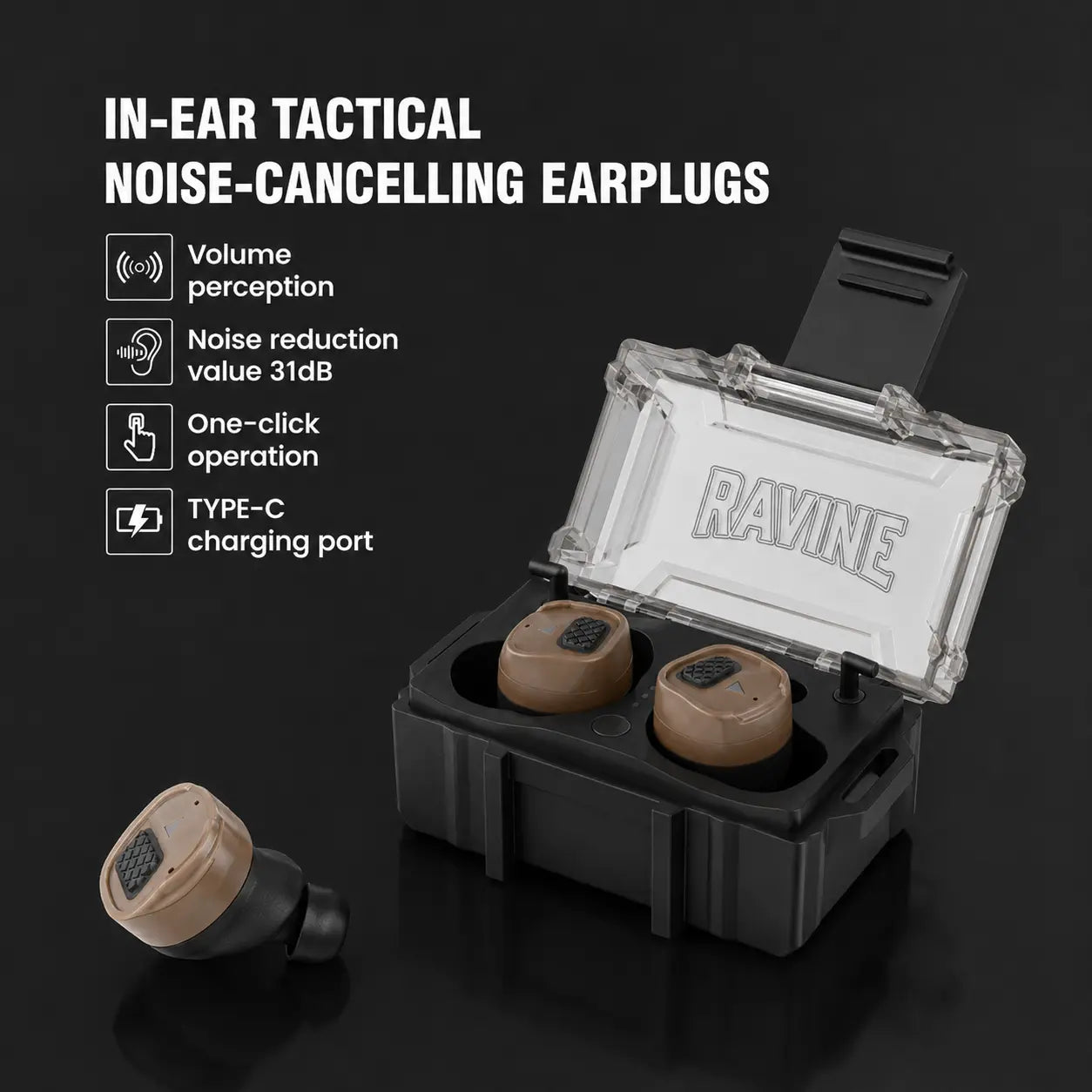
What drew me to the Ravine FieldPro was the claim of 31 dB noise reduction. I have a inexpensive set of Walker’s Razor Slim Passive Earmuffs that are rated at 27 NRR. I have some Flare Audio Isolate ear plugs that are rated at 30 dB (Compared to the muffs, I don’t think they quite deliver that. Good, but not 30 dB good). Paying for one more decibel might not seem like much but the scale is logarithmic so that one point counts for a lot of energy.

The FieldPros also offered ambient noise amplification, Bluetooth, and a lifetime warranty. I read reviews online (not those at their site) and they were good. One guntuber compared an assortment of active noise reduction earbuds and rated Ravine at the top.

They were on sale, I had just come into some additional cash, so I placed my order.

The first red flag was shipping. My order was responded to quickly with several personable emails but the link to the shipping tracking didn’t work. For that, I blame my anti-malware software. It’s a thing that happens. But, when I looked into it, I found that the shipping company was a Chinese company I had never heard of with its claimed main office in Germany. I have dealt these sorts of scammers before.

An online search also found what appears the be the same product offered on Amazon by an assortment of Chinese random-name companies. Most things in the American market, even those from American companies, are manufactured in China, so this is not necessarily a bad sign. I hoped those two things didn’t mean I was getting something shipped directly from China for when there is a problem they often want to you ship any defective product back to them in China at a cost that might have you just taking the loss.

It took a week to receive the email that my order was even out for shipping but it only took a week for the package to arrive. The originating address was Wisconsin so that flag was put away. Though having a Wisconsin address, registering your domain from a Canadian address, using a Chinese shipping company that has its main office in Germany. . . maybe the flag is still there.

The earbuds were charged out of the box. The Bluetooth paired successfully. The ambient noise amplification worked. I noticed a momentary delay between, say, snapping my fingers and hearing the snap amplified, but that would be expected. I didn’t seem to have binaural hearing. The sound arrived in both ears simultaneously (or so it seemed). Can’t say I would want that while hunting but I didn’t expect to need that feature. I didn’t have any way to test the noise canceling for another two weeks when I would get to the range.

Failure.

I had double checked that they were on, the ambient noise canceling was working, the Bluetooth was working, but when I fired my rifle I could detect no noise canceling effect. Even from having plugs and device blocking my ear canal. It was if I didn’t have anything in my ears at all.

I checked the manual, confirmed everything was as directed, fired a few round with my muffs on as a baseline and tried again with the FieldPros.

Again, failure.

When I got back home, I immediately went to their website and submitted a report describing the issue in detail. I immediately received several automated responses indicating that, it was a weekend so they would be back on Monday, and that a service ticket had been opened.

Then nothing for a week. Another red flag. Almost nothing, anyway. I received a canned email asking me to review their product. My response was not kind and I attempted to respond to the service address in that email but it bounced. I tracked down another email address and sent another report. Again, I received immediate automated responses about the weekend and service ticket.

I did receive a response this second time where I was prompted to do some troubleshooting. Even though I had already described having done that troubleshooting I did it all again and said so.

They refunded my money.

Normally, you would not think getting a refund as being a red flag but I had also gotten the Lifetime Warranty. I would expect more troubleshooting. Repair or replacement. The kind of thing you do when something that someone wants is broken. You know, actual warranty work. Getting a refund instead of repair or replacement tells me as a customer that they don’t actually stand by their product and the warranty is just a marketing ploy.

I fear this is a trend. The current administration being a grift without consequence has telegraphed to businesses that the rails are off and they are free to scam people as well. Not that Ravine is a scam, necessarily. The public reviews seem to support that they have an actual product that can work as advertised, but when something doesn’t work, well, there is no incentive to make it right. Just send the money back and fill a new order by some unsuspecting customer. Competition not by making a better product or offering better support but by spamming and mass shipping and making bank on sheer volume.

Oh, and one of their posted ads is entirely AI slop, so marketing is operating under the same pump and dump business model.
dime_novel_hero: 2018-present (Default)
Fear is a strange thing. Case in point, myself.

One time I was riding the Montour Rail Trail, specifically visiting Greer's Viaduct at the then end of the current trail which was set to be refurbished and carry the trail across Chartiers Creek. I wanted to get some pictures of that bridge before that happened.

The bridge had been unused and abandoned. The metal access walkway was rusted through in spots. There were trees growing on and through the wooden ties. It was a death trap and at any time a part might collapse and drop 40 feet to the creek below. And I had absolutely no trouble walking out onto this structure to take pictures. I could look down through holes in the structure to the creek below. No problem.


Parallel to this bridge is another lower track, Bell's Viaduct. This bridge is active rail so that the old wooden ties have been replaced by concrete. It is also only 20 feet above the creek.

And I could not walk out onto that bridge. I was overwhelmed. Almost paralyzed.

For another instance, I had an issue with the gutter of my house and to reach up to the second floor I had a 6 foot folding ladder precariously balanced on top of wooden shipping crate. I was standing on the top rung and holding on to the insulated main electrical line with one hand while I stretched around the corner of the house to fix the gutter.

Yes, it was stupid but I did that. No problem.

But, reaching up to the same gutter using a proper length ladder with someone holding it steady at the bottom so that I could hang lights? That was made of nope. I did it but I hated every second of it.

On my vacation to the Gettysburg Battlefield, there is a National Park Service tower on the southern end of Seminary Ridge, the so-called Longstreet Observation Tower. Built in 1896, it stands 75 feet tall and has wide stairs with railings. Railings all around the platform and a cozy roof. Its stairs are as safe as any staircase in a home or commercial building.

And I could only climb about half way up before I couldn’t any more. I will say that climbing the observation tower at Oak Ridge wasn’t a problem. It is only 23 feet tall but I didn’t have the rising dread with each step. I climbed to the deck atop the Pennsylvania Monument and was fine.

Is it some sort of weird wiring in my brain that makes my fear inversely proportional to the actual or imaginary risk? Maybe if the Longstreet tower were dilapidated and rusted through I would be less stressed.


dime_novel_hero: 2018-present (Default)
During my vacation to the Gettysburg Battlefield, I, of course, shopped. There was The Union Drummer Boy and For the Historian just a few doors down from where we stayed. Baltimore Street Books and Antiques, The Maryland Sutler, Ladies and Gents 1863 Boutique, Gettysburg Emporium, and The Horse Soldier.

The Regimental Quartermaster is primarily focused on reenactors and living historians and there I saw a pair of 1862 infantry manual reprints. A quick glance seemed to have them very similar, one by Brigadier General Silas Casey and the other by Brigadier General W. J. Hardee. I was curious whether there was any functional difference between the two so I took them up to ask the man behind the counter.

In his slight but obvious Southern drawl, he said that he didn’t know, that he had only started working there two weeks past, and that “Nobody wants to work any more.”

I hadn’t asked for or prompted him in that direction but he was, for some reason, compelled to let me know that the Lost Cause narrative was alive and well here north of the Mason-Dixon line.

The current of history flows something like this. Abraham Lincoln chose Democrat Andrew Johnson as his running mate during the election of 1864 as a demonstration of national unity. When Lincoln was assassinated, now President Johnson threw in almost entirely with the former Confederate political power base and entirely wrecked Reconstruction. This allowed for the Klan and Jim Crow. That restorationist conservationism and reclaiming of white power lead into the Gilded Age, Woodrow Wilson showing “Birth of a Nation” in the White House, and the inevitable collapse of the Great Depression. Long suffering southern blacks had enough and initiated what became called The Great Migration and millions moved north during the inter-war years. Since Southern conservatism had also kept poor whites poor and was making them poorer, they finally took the hint and also moved north, bringing the Lost Cause narrative and a resurgent Klan with them. After World War Two, Nixon’s Southern Strategy told them the Democratic party, the party of Andrew Johnson and Woodrow Wilson, was no longer racist enough to represent their family values and they became Republicans. The Dukes of Hazard generation then traded their Confederate rebel flags for the yellow Gadsden flag, calling themselves little-l libertarians, but when MAGA came along they sided with the fascists because, all the way back to their antebellum slave owner class ancestors, that’s what they always were in their hearts. So, when they say “nobody wants to work any more” what they really mean is that they miss the days when they could sit on their fat asses drinking mint fucking juleps while brown people slaved in the fields for them.

Checkmate Lincolnites!

Oh, and the difference between the infantry tactics of Casey and Hardee? Hardee wrote his manual earlier based on French manuals but later betrayed his country to join the Confederacy. Casey based his manual on the same French manuals but also on other manuals, including Hardee's, while adding expansions of his own. 

You can guess which book I purchased.
dime_novel_hero: 2018-present (Default)
It had been well over a decade since I had last visited Gettysburg and if I was going to have a vacation there, I was going to make the most of it. That “most” would include a horse tour because my steampunk dime novel hero persona demanded it. I haven’t been on horseback since I was a kid.

My college friend Paula has worked with horses all her life and had moved to South Mountain after graduation and so I asked her for a recommendation. Though she was currently working for a draft horse rescue, she had previously worked for Horse Tours of Gettysburg and I signed up. (link)

This is Adler. He would be my chauffeur for the day.


Getting on Adler was a slight challenge because he is a big boy and I haven’t ridden a horse in almost 50 years. And then, it was a smaller animal as I was also a smaller human way back when.

I was warned that Adler was something of a slowpoke, and he did fall behind a bit. Corporate shills have invented the term “quiet quitting” but, in fact, Adler was a professional doing his job. And nothing more. He wasn’t getting paid to do any more than follow the horse in front of him and he did just that, with some added distance because, well, there are those horses that don’t like tailgaters. He had a tendency to drift to the right and I can appreciate that. I would want to walk on the softer grass as well but that is not good for the trail and, with a normal amount of encourage, Adler would return to the center of the track. As a professional.

Paula later shared a video of Adler and the other horses being released into the field after a workday and Adler was as spirited as any of the other horses, showing that, indeed, he had been working to task and, once the workday was over, he was done working. (link)

So say we all.

The route of the tour paralleled Confederate Avenue along the backside of Seminary Ridge. The trail cut through McMillan Woods, through the Spangler Farm, then across the Emmitsburg Road to the Trostle Farm. From there, it returned along the same trail. About four miles overall.

All along the trail, we had a radio in our ears relaying the narration of our licensed battlefield guide. For the two hours of the ride he kept up a constant stream of accurate and entertaining historical information. I learned more about wooden fences than I ever thought I would.

Two hours was not enough. I could easily have ridden and toured much more. I notice on the Park Service Map that there is another branch of the trail that splits off the one I rode at McMillan Woods, to Warfield Ridge and the loops past the base of Big Round Top. That would more than double the overall ride. I wonder if that option is available.

My friend Paula was waiting for us on our return. She said that I had good posture which is a fine compliment for not having ridden since I was a kid.


Getting down off the horse was somewhat inelegant. Again, for not having ridden for a very long time but also, I think my stirrups were still a bit low. I had gotten them adjusted when we paused at the Spangler Farm but I didn’t think they were cinched up quite enough.

A horse tour is highly recommended and specifically Horse Tours of Gettysburg did a fine job. Well worth it. I will definitely want to find an opportunity to go riding again if not with them at Gettysburg than at some other venue.
dime_novel_hero: 2018-present (Default)
In Ron Maxwell’s 1993 film “Gettysburg”, Longstreet describes to the spy Harrison what to expect on this the third day of the battle, what would become known as Pickett’s Charge. If his description is insufficient to impress upon the viewer the carnage that is about to unfold, Maxwell’s direction and a thousand middle aged reenactors hauling their fat asses across that field with static camera shots and the occasional repetitive stunt work only enhances the inadequacy of Longstreet’s prediction.

Actually standing on that battlefield, looking across that mile of open ground, you can begin to understand but, even then, just the space itself is not enough to make it real. You need the context. You need the details. Without having cannons and rifles firing at you, there needs to be, unfortunately, a lot of math.


On the afternoon of July 3rd, 1863, approximately 14,000 Confederate soldiers stepped out of the treeline on Seminary Ridge and began advancing across the field. That field was, at it’s center, about three quarters of a mile across but, as the Confederate line stretched nearly a mile end to end, those soldiers on the right flank faced a distance of a mile and three quarters. If you are able to visit the battlefield, you will find the National Park Service has a grassy path available for you to cross at a distance of a little less than a mile

1,500 yards.

Imagine yourself and a busload or so of tourists stepping out onto the field to recreate Pickett’s Charge. Seventy-five of you lining up next to Robert E. Lee’s statue. There is a fence to your left that points the way. You form up on grass but ahead on the left, on the other side of the fence, is a wheat field. To the right is some corn. Straight ahead in the distance is a low rise. The monuments stand out white but the rest is just a blur. Your destination is a clump of trees.

When I was in high school I was in a championship high school marching band and when I walk to exercise at lunchtime, I still move at the pace and gait I learned then; 8 steps in 5 yards at 110 beats per minute. A brisk 3 mph that is common for all parades and infantry marching manuals. The crossing will take you a little over an hour. You step off.

Then the cannon open up.

Union artillery batteries average 6 guns per battery though, with the losses of previous days, the 29 batteries on Cemetery Ridge is somewhat underpowered. There are about 115 guns active. And though they are spread out over a mile of the ridge, with you at the center of the line, they can all come to bear on you. The guns are an assortment of different calibers but most are 3 inch Ordinance Rifles and 12lb Napoleons, firing 9 pound and, of course, 12 pound solid shot or exploding shells. Firing all at once, the ridgeline explodes silently with fire and white smoke. Three and a half seconds later, the iron balls rip through the line. A man struck by a cannonball looses whatever it was that was struck. An arm. A leg. His head. The rest of the body doesn’t even have time to react and simply drops where it is. Struck in the chest and he ceases to exist. A half second later, the thunderous report.

Advance.

In thirty seconds, you will have taken 55 steps. Thirty-four yards. The artillerymen on the distant ridge have reloaded and fired again. Another half-ton of iron arrives. This will repeat 40 times.

Half an hour.

You haven’t been able to keep that brisk marching pace, what with the nearly 90 degree heat and ton of hot death raining down on you every minute. But you have made it three-quarters of a mile to the Emmetsburg Road. On the near side, there is a fence you have to climb over. The road beyond is slightly sunken so it might provide some cover, but another fence to climb over is just beyond that.

Climbing over the fence, the infantry opens fire.

Two hundred yards ahead is a low stone wall and behind that are federal infantry. A regiment might normally be composed of a thousand soldiers but, with attrition over the course of the war and the previous days’ battles, a regiment might field several hundred. The 71st Pennsylvania Regiment is behind that wall with 331 men, most just behind the wall but several companies further up the hill. At two hundred yards you see them as a blurry line of blue behind the stone wall. A good, well ordered soldier can load and fire his musket three times in a minute. With four lines firing in sequence, three score rounds every 5 seconds.

This close to the wall, you are no longer under the murderous gaze of the entire ridge line of artillery. Instead, there are only a few batteries with you in their sights, a battery 50 yards back from the wall and to the right, another straight ahead but further back atop the rise. They have, however, switched over to canister shot; 9 pounds of thumb-sized iron balls fired like a shotgun, shredding a dozen soldiers at a time. They are still firing every thirty seconds and, should they feel the inclination, might fire double canister.

Two hundred yards to the wall.

As you are in range of Federal infantry, so too are they in range of your guns. After a half hour of walking across that hellish field with your rifle on your shoulder, you line up after crossing the fences and the road to finally return fire. Reload. Fire again. Ten, twenty, fourty times.

You stand, fire, and advance for 15 minutes.

But you are still a hundred yards from the wall. You can see their faces. They can see yours as they aim and fire. Another 20 seconds, another report, another ounce of soft lead finds its target. A hundred times over. At this range with soldiers packed together, every shot is likely to hit something.

“Give ‘em the steel, boys!”

Run the last 100 yards to the wall to be met with a line of bayonets. Sixteen inches of steel. And pistols. And sabers. And fists. Blood and guts making the stone wall slippery. If you are able to push your way over the wall and the bodies you are among them now. A violent soup of blue, gray, and red. Ten horrific minutes of this and the Federals begin to fall back. Maybe a cheer goes up and for a moment it seems like the tide has turned. There are several artillery pieces there for the taking. You run up to them, turn turn them back on the Federals, but there is no more ammunition. Fifty yards ahead, the 71st Pennsylvania has reformed at the top of the rise. There is a battery of artillery that hasn’t run out of canister. Men from Delaware and Connecticut are to the left. To the right, between you and the trees that were your destination, another Pennsylvania Regiment and men from New York.

Turn around. . .

You are alone.

That busload or so of tourists that started out with you back beside the statue of Lee. . . 75 people. . . are gone. Of the 14,000 soldiers they represent, half died on that field, the rest staggered back to Seminary Ridge. You alone represent the few hundred that made it over the wall. The high tide that was never going to be enough to win the day.

“General, I have been a soldier all my life. I have been with soldiers engaged in fights by couples, by squads, by regiments, by divisions, and armies, and I should know, as well as anyone, what soldiers can do. It is my opinion that no fifteen thousand men ever arrayed for battle can take that position.”

Longstreet was right. It’s been a little over an hour since this walk began.

Look back over that wall, over that field, over that time, imagine yourself a poor Southern dirt farmer off to war and that all of this death and devastation was so that, back home, rich Southern landowners could profit through the enslavement of poor people. People just like you excepting the color of their skin.

This was the cause.


dime_novel_hero: 2018-present (Default)
Touring the battlefield at Gettysburg, my partner, in looking up at the rocks of Little Round Top from The Valley of Death said;

“I’m no military strategist but even I can see that is made of nope.”


I am reminded of an NPR interview from some years back covering restoration of the Lincoln funerary train. The interviewer related that many thousands of people turned out along the tracks to watch the train carrying Abraham Lincoln home after his assassination in 1865. She used the term realization.

The modern usage of this word is along the lines of learning something or knowing something you didn’t know before, but it’s 19th Century usage was having something made real in your mind. You can read about something or know about something but that is different from the experience of having it made real to you. It can be a difficult distinction, it is the same word after all, but it is distinctive.

Some years ago, years before this NPR article, I had won a vacation to California. Stayed near the beach in Santa Monica, visited a TV set, met cast and crew. On the last day, I was in Hollywood doing the tourist thing and decided I wanted to see the sun set over the ocean. Another tourist thing, I suppose. And, instead of heading back to the hotel, I headed north along the Pacific Coast Highway looking for a good spot.

I wasn’t finding one. The sun was getting lower and lower and I was not finding a place I could pull off to see the ocean.

Finally, round about Malibu, I found a pull off. There was a cliff across the road that looked down on a small beach where some guys were surfing. There was a rise that would offer a vantage to see the ocean but there was also a sign warning that this was an archaeological site. I read the sign carefully and it did not exclude people from the site, just advised not to disturb, change, or take anything.

On the rise there was a rock to sit on and I had gotten there just in time to see the sun set over the Pacific Ocean. Except that didn’t happen. There was an island in the way. I had rushed all this way to be foiled by the silhouette of an island, blocking my view.

I was disappointed. I looked around this rock and saw stone chips. The vantage. The archaeological sign.

For hundreds or maybe thousands of years, people came to this place to fashion stone tools. They could have made those tools where they found the flint or they could have made them back at their homes. Instead, they carried them here because, just at sunset, they could pause from their work, look up, and out near the horizon they would see something that the haze of distance and daylight kept from them otherwise. A magic island.

Realization.

I made real a moment, a connection, a deep understanding beyond what I could ever know from a book, a photograph, or even the knowledge that such a place existed. That moment was so powerful, so meaningful, so singular, that I cried. I’m crying a bit now. It was that real. Years later it remains that real.

And I think about the experience of those people lining the tracks to watch a train go by. Of my partner looking up a hill south of Gettysburg. Of my sitting on a rock on the Pacific coast. Of places where important things happened. Of places where mundane things happened. Of places where people lived. And died. Of moments made real and how important it is to protect and nurture those places. Battlefields. Museums. Zoos. Trails.

Spaces that can touch us and make us human. Make us all real.
dime_novel_hero: 2018-present (Default)
For my vacation in Gettysburg, I purchased the Self-guided Auto Tour from ActionTourGuide.com having seen it highly recommended online. In my last visit to the battlefield several decades ago, I had used the National Park Service tour on CD and thought this app, loaded on my cell phone with GPS prompting, would be more complete and easier to follow.

Herein follows the letter I wrote to Action Tour Guide concerning their product.

I am not a historian but I am a history enthusiast. I have read any number of books and have watched many documentaries and short video presentations. I have myself presented at many conventions over the past decade and more on varying topics of 19th Century science, technology, and history. More important than that experience, though, is that I know how to check my sources and research with reputable and even primary sources before expounding on a topic before an audience.

In your case, this appears not to have been done with sufficient rigor. Right off the bat, at the very beginning of the tour:

“Here, Union forces staged a nearly impossible defense against Confederate attackers – and won!”

No.

It was the Confederacy that was desperate for a victory with the near impossible goal of ending the war that had gone on for two brutal years with a daring end run around the Union army to attack Harrisburg, Philadelphia, and perhaps even Washington, or to defeat the Union army in a single, decisive battle. Lee’s Army of Northern Virginia entered Pennsylvania with roughly 75,000 soldiers. The Army of the Potomac in pursuit outnumbered the Confederates with about 100,000 men. Lee was in enemy territory, having to steal supplies from locals to support his already underfed army. He had split his forces in multiple parts and scattered them across the Pennsylvania countryside to forage. He was unfamiliar with the terrain. His cavalry under Stewart was out of touch and providing him no intelligence of the Union army’s movements or disposition. Once engaged at Gettysburg, he had to wait to gather his forces while the Union army held the high ground at all times. The Union had the advantage through the entire campaign.

“Here, Confederate forces staged a nearly impossible attack into the North – and rightfully got their asses kicked.”


I could grant that this introductory statement was presented with dramatic license but, in the very next section:

“Lee first aims to enter Columbia, but a regiment of Black soldiers under General Jubal Early burns a bridge and blocks his way. This temporary setback ends up changing the course of the war. Lee points his army instead towards Gettysburg, where Union forces appear vulnerable.”

Amazing. Everything you said was wrong.

Columbia wasn’t his first aim by a long shot. Jubal Early was a Confederate general under Lee’s command, not part of the Union opposition. As a Confederate, Early did not command a regiment of Black soldiers. Lee did not turn to Gettysburg because the Union appeared vulnerable there.

My best guess concerning what this part of the narrative is supposed to convey is that in late June, as Lee’s Army of Northern Virginia invades central Pennsylvania, a flying division under the command of Jubal Early captured York. From there, he sent a brigade east under General John B. Gordon to cross the Susquehanna River at the Columbia-Wrightsville Bridge into the town of Columbia and from there, attack Lancaster, and then move north to capture Harrisburg.

Gordon was met by several companies of Pennsylvania Militia, one of those was composed of black soldiers. Outnumbered five to one, the Union militia retreated after a short delaying fight and attempted to demolish the bridge with explosives. When that failed to deliver enough damage, they set it alight with coal oil and kerosene.

Shortly after this, Lee recalled Early’s division to join the rest of the army at South Mountain. His army was spread out all over central Pennsylvania and, as Union forces came up from the south, Lee needed to bring all his forces back together to meet them. Gettysburg was a hub with roads coming into it from seven different directions and was a natural congregation point. He didn’t know the Union was vulnerable there. In fact, he didn’t even know the Union was there. Because it wasn’t there. They were still on the march. And, in issuing his recall order, I’m not sure that Lee was aware that the bridge had been burned.

I get that you wanted to tell this story in a single, quick paragraph, but in so doing, you got it very, very wrong.

Next to the wheatfield.

“While fighting rages on at Little Round Top, now behind us, Union soldiers stationed here notice something strange. . . Is something stirring in the wheat?

Yes – Confederate soldiers! They’re charging towards Cemetery Hill, where the center of the Union is vulnerable!

The Union men surge forward to prevent this attack.”

While dramatic and almost cinematic, it is not the way things unfolded in the Wheatfield.

General Sickles had already moved his units off of Cemetery Ridge to Rose Woods and the Peach Orchard when the attack began. He had seen the rise as a better vantage to defend against Confederate advance from the Devil’s Den to the south and the bulk of the forces on Seminary Ridge. (He was wrong.) They didn’t advance because they saw Confederates attacking, they advanced to block an expected advance that hadn’t happened yet. And they did not see Confederates sneaking through the wheatfield because the wheatfield was behind the Union line when the fighting started.

And it is my understanding that wheat, like that planted in that field to this day, grows to about thee or four feet. Even at its full chest height, it would not be tall enough to conceal a Confederate brigade.

Additionally, Union troops marched through the wheatfield to take up position along a stone wall on the edge of the woods, laying down much of the wheat. By the time they were pushed back by advancing Confederate forces, the wheat would be completely trampled. No wheat for them to stir in.

Are you confusing this with Miller’s Cornfield at Antietam? Are you not aware that advancing through a field like that does not conceal movement but does make it nearly impossible for the advancing soldiers to see the enemy on the far side? Did you just make it all up for dramatic effect? In any case, nothing happened as you described.

The next textual instance that had me literally yelling at the cell phone on my dashboard came on Cemetery Ridge:

“It’s July 3rd. Lee confides his ambitious plan to Longstreet: he wants to send a massive charge directly at the center of Union lines on Cemetery Hill. Longstreet disagrees, unconvinced that another such attack will succeed. He’s overruled and General Pickett takes command of the hail-mary operation.”

What the actual fuck! No, really. Where are you getting this from because in no way, shape, or form did Pickett “take command of the operation.”

Lieutenant General James Longstreet commanded a Confederate Army corps and had three divisions. Those divisions were commanded by Pettigrew, Trimble, and Major General George Pickett. Longstreet did disagree with Lee’s decision but Lee did not take the command away from corps commander Longstreet to give to the lower ranking and less experienced division commander Pickett. Longstreet followed Lee’s orders and continued in his command.

For all the mistakes and dramatic license taken by Ron Moore in the 1993 movie “Gettysburg”, bordering on Lost Cause propaganda itself, even he didn’t get this wrong.

It became known as Pickett’s Charge not because Pickett was in command of the entire operation but because he was the most flamboyant of the division commanders, was a Virginian commanding mostly Virginians in the Army of Northern Virginia, won the argument with North Carolina over who was to blame for the attack’s failure, and is credited with delivering one of the most memorable post-battle lines in movie history.

It’s known as Pickett’s Charge because of politics and propaganda.

And these are just the errors I recognized during the tour. They are so egregious, so counter-factual, that I can only conclude that there are many other mistakes to be found. I’m sure if I sifted through the narrative again, I would find more.

But that’s not my job. It’s a job you should have done well before recording.

I am also sure that these errors have been pointed out to you previously. I can’t imagine that all of the thousands of enthusiasts, more enthusiastic and knowledgeable than I am, took this tour and just let these errors go unreported over the many years it has been available. These things have been pointed out to you, assuredly numerous times, and you have actively decided NOT to correct them.

Action Tour Guide, not only will I not recommend your product, I will actively work to dissuade people visiting these sites from engaging with your product. My bundle purchase of the Antietam tour, expecting to visit that battlefield again perhaps later this year, will be deleted from my phone. The information presented simply cannot be trusted and the events at these battlefields are too important to be left to those so unconcerned with accuracy.
dime_novel_hero: 2018-present (Default)
My family settled in Hanover in the early 18th Century so, in my vacation to the Gettysburg Battlefield, I was required by my own history to visit the ancestral homelands.

Family oral history tells of a pair of Union soldiers who hid in the family barn to observe J.E.B. Stewart’s cavalry as it advanced on Hanover 30 June, 1863. I had read several books on the Battle of Gettysburg and events leading up to it but had never read anything to either confirm or refute this story. It seemed a small historical sidenote and so would not find its way into the main historical narrative. Yet, I kept my eyes open.

An internet search suggested a title and an e-Bay purchase obtained for me a copy of “Encounter at Hanover”, a collection of articles and essays collected by the Hanover Chamber of Commerce (1963). Page 100 contained my answer:

“A few minutes after ten o’clock, loud yells and shrieks were heard out the Westminster road, one hundred yards from Pennville. The 13th Virginia Cavalry came dashing down the road and just as these mounted men were approaching the rear of Farnsworth’s brigade, they fired a volley from their carbines. This was a signal for the opening of the engagement. It was the 18th Pennsylvania Cavalry, commanded by Major Darlington that received the first attack of the enemy.

“In a few minutes,” says Mr. Forney, “the fields immediately north of the Littlestown road and west of Hanover were filled with mounted soldiers. The Union troops had quickly fallen back through town to the assistance of the rear regiment which had been attacked.”

While the air was filled with yells and shrieks, and the opposing forces were in deadly combat along the Littlestown and Westminster roads, the Forney boys unhitched their horses and hastened with them across the fields toward McSheerystown, while the enemies balls were whistling over their heads. They escaped to the Geiselman farm where they remained until late in the afternoon. Twenty-two dead horses lay along the road between the Forney farm and Keller home on the Westminster road that evening. Mr. Forney helped to drag these dead horses away the following day. When he returned to his home in the evening, three wounded Union soldiers and one Confederate were lying in the front room on the northwest side of his home.”

--- From Samuel Althoff’s Narrative of the Cavalry Engagement In Hanover On June 30th, 1863, Record Herald, Hanover, Pa., Saturday, July 1, 1905

And so, it wasn’t two Union soldiers hiding out at the family farm but two local boys. It should not be surprising that in 150 years of retelling, details had changed.

My father and grandfather, keepers of the family history, would have very much liked to have heard this story.


dime_novel_hero: 2018-present (Default)
The adventures of Vitruvius Pike, Dime Novel Hero, begin at the Gettysburg battlefield in 1863. In the real world, it has been decades since I had the chance to visit and finally had the chance again this year. And it would not be the rushed, single day visits of previous tours but several leisurely days.

It began with relevant historical readings and viewings. “Gettysburg” (1993), “Encounter at Hanover” “The Maps of Gettysburg”, Ken Burns’ “The Civil War”, an assortment of videos from the American Battlefield Trust, and “Abraham Lincoln: Vampire Hunter.”

Then, the drive. The PA Turnpike to Harrisburg, then south to York, and then back towards Hanover because my family settled there in 1739 and there were sites I wished to visit. My Great great great great great great great great grandfather’s headstone is looking pretty worn and I would not have been able to recognize it as such without knowing what I was looking for. I recall when I first saw it it was in good enough condition that I was able to read all the text and recognize the differences between what would have been his native German and the “Pennsylvania Dutch” syntax of the stone.

My drive, of course, included music. Civil War soundtracks, re-enactor bands, and other selections from my CD shelves. I also downloaded several “Songs of the Civil War” albums but found too many Confederate songs. There were a number of songs about how proudly unreconstructed they were “and I took that personally.” I will need to curate my collection much better. I don’t need “Songs of the Lost Cause”.

In Gettysburg proper, we would be staying at the Brafferton bed and breakfast. Originally the Codori house, it is the oldest deeded house in town, built in 1786. I had hoped to get a more historic room, in the front with a musket ball embedded in the mantle, but instead had to settle for one in the back. It had a deck and was surprising quiet for the house being right on the main street through town so I was not disappointed.

Codori is a big name in and around Gettysburg. The Codori brothers started with a butchery behind the York Street house. Pickett’s division marched through the Codori farm on the Emmetsburg Road on the third day of the battle. I saw the Codori name repeated throughout town on a gift shop and a monument mason.

Dinner was burgers at the Blue & Grey Bar & Grill’s patio right on Lincoln Square. They have on their menu a Longstreet burger with peanut butter(?). I had to ask why peanut butter and was told that apparently Longstreet liked peanuts. Fair enough. I am too much a Yankee to have a burger named for a Confederate and so had the burger honoring Union General George Meade. As Meade was from Philadelphia, his burger was, of course, a cheese steak on top of the patty.

Did some shopping around downtown Gettysburg. I found a 4-pack of Leninade at Sweet! Candy and Soda. Bought some archaeological bullets and canister shot at The Union Drummer Boy. Resisted buying an armload of Osprey books at For the Historian bookstore. Didn’t find any modern surplus I needed at National Soldier Factory.

Thad’s Place was the Thaddeus Stevens museum and though it was after the posted closing time, the “open” sign was still up and the proprietor welcomed us with a tour. I purchased a shirt I will be wearing at the community picnic on Juneteenth.


I am an early riser and so breakfast at 8 am was a little late for me. Spent the wait time reading a Thaddeus Stevens biography.


The day was for the driving tour of the battlefield but it did not get off to a good start because of the locations of restrooms. Ended up back at our hotel. Then, some shopping down Baltimore Street. The Maryland Sutler had the right shirt for Octavia but not in the right size. She did find a skirt and shirt at
Ladies and Gents 1863 Boutique next door. Gettysburg Emporium had a very nice vest but it was not in my size. I purchased Casey’s “Infantry Tactics” (1862) at The Regimental Quartermaster.

After noon, we got back to the task of driving the battlefield tour. We were guided by the app purchased and downloaded from Action Tour Guides and, I won’t go into it here but there were issues. Some of which had me literally yelling at the phone on my dashboard. I will go into that in more detail in a later blog post (link).

There will also be another subsequent blog post going over some thoughts about battlefields and the realization of history (link).

Vacationing is a rare occurrence for me and so I want to make the best of it. Or not. I want to see different places and try different restaurants but also, sometimes, just want the quickest, easiest, or the most inexpensive food. For dinner the second day, the latter inclination won out and we were back at the Blue & Grey. I had the salad.


Yes, that salad consists of chopped brisket, pulled pork, Andouille sausage, and bacon.

Once was a time when I was going to steampunk conventions on a regular basis and I had a travel bag with sundries already packed. This was no exception as my shaving kit was already ready to go. But the morning of the third day taught me a few things. The boar’s hair bush in my travel kit is so much better than the synthetic brush I use regularly at home, even though it lost a number of bristles in the process, perhaps for having sat unused for so long. Also, the Taylor of Old Bond Creek shaving cream I have in my kit is so much better than the Giant Eagle hockey puck I use regularly at home. The Astra razor blades I had in my kit are not as good at the Shark blades I use regularly at home.

These revelations will not change much of my shaving behavior at home, though. I do not have a public-facing job, no one sees me at my workplace, and so I only shave once a week when my face starts getting itchy.

After shaving and dressing, the thirst day was much the point of the trip. On advice of a friend from college I signed up for a battlefield tour from Horse Tours of Gettysburg.

The staff, the horses, the tour guide, the scenery, and even the weather were all most excellent. I would certainly do such a thing again. All the details will be expanded on in a subsequent blog post (link).

My college friend had once been employed by the horse tour (she is now working at a draft horse rescue) and though she wasn’t one of the guides for the tour, she met us afterwards and we spent the afternoon catching up, having lunch, and afternoon tea.

Dinner was back at the Blue & Grey because brain no worky after a long day.

And finally, the retreat from Gettysburg had a few more shops to visit. The Horse Soldier had lots of authentic Civil War artifacts so everything was out of my price range. I follow Paper Cartridges on YouTube and so visited his shop. He also restores pocket watches.

It has been a long time since I truly vacationed and Gettysburg was totally worth spending several days. Even then, there were more battlefield things I didn’t get to. I didn’t see the NPS museum. I didn’t see the cyclorama. I didn’t walk Devil’s Den or Little Round Top. I didn’t walk Pickett’s Charge. Did you know that the Homestead Diorama Museum details famous Civil War battles with cat miniatures? Definitely worth coming back for.

Although I am also thinking a trip to Antietam would be in order.
dime_novel_hero: 2018-present (Default)
In a week or so I will be visiting the Gettysburg National Battlefield. In anticipation of that trip, I have been studying the topic a bit so that, when on site, I know and have a somewhat deeper understanding of what I am looking at. Of course, this preparation involves yet another rewatch of Ron Maxwell’s 1993 movie “Gettysburg.”

There is a lot to both like and dislike about this film but what I was prompted to think most about on this re-viewing comes from the scene where, on the morning of the Second Day, Tom Chamberlain talks to several captured Confederates. He asks, “Why fight this war.”

“I’m fightin’ for mah rats. Why is it you folks jus can’t live the way you wanna’ live and let us live the way we do?”

Because the way you want to live involves enslaving four million people, you goddamned fucking piece of shit!

OK. Tom Chamberlain didn’t respond that way, but I certainly did. It’s pretty clear that, for the narrative, Ron Maxwell, and before him author of “The Killer Angels” Michael Shaara, wanted to give voice to all the reasons that people fought and not just the singular, overarching and overwhelming reason it was actually fought. . . .

Slavery.

But let’s give some benefit of the doubt here and ask that soldier, more specially and perhaps with citations, what particular “rights”, not rats, he is talking about. How were you living that the Lincoln administration would have you not? What rights were the United States federal government abrogating that the Confederate constitution was protecting, reinforcing, or granting?

The answer to that is. . . nothing. For a clearly dirt poor and probably illiterate subsistence farmer in the south, as this character likely was, there were no changes between the previous Federal constitution he was living under and the Confederate constitution he had taken an oath to fight for that would have any direct effect on his existence. There was nothing in the Federal constitution telling him to live a certain way to live that wasn’t also contained in the Confederate constitution. And, even if there was, his life was and would be much more impacted by his state’s and local laws, and those had not and would not change after secession.

Shaara seems to recognize this as the novel has a line (spoken by Tom Chamberlain) that was not included in the movie . . .

“I asked this fella what rights he had that we were offendin’, and he said, well, he didn’t know, but he must have some rights he didn’t know nothin’ about.”

So, he’s fighting for his rights without having any idea what rights those are. He is fighting for “The Cause” without knowing what the cause even is. And he is, apparently, totally OK with that because he was told the case was important. Vital. Noble. Existential.

He wasn’t told it was lost. That only came later after the Confederacy was destroyed and former generals felt compelled to come up with a cause that wasn’t slavery.

The seeds of that narrative are spread wide throughout the “Gettysburg” literary and cinematic landscape.

Lee mentions The Cause but completely avoids any intimation of what that cause is.

Armistead gets to give a speech about “victory” and “old Virginia” but that is as much of The Cause that is articulated.

Longstreet says “Should have freed the slaves THEN fired on Fort Sumter” which is the weakest repudiation of slavery as the cause as one can have without being silent altogether. In the novel, however, Longstreet is speaking with Armistead about slavery. . .

“Longstreet said nothing. The war was about slavery, all right. That was not why Longstreet fought but that was what the war was about, and there was no point in talking about it, never had been.”

There is that, at least, but nothing about what Longstreet’s case is in all this.

Kemper, previously a speaker of the Virginia House, should have been able to clearly and comprehensively articulate what The Cause was about but, instead, goes on about how he looks on governance as a gentleman’s club and that, if he disagrees and wants to leave some club, he should be able to just walk out. So, allow me to ask you Mr. Speaker, if that is the case then why was such a fuss made when Western Virginia seceded from the Confederacy in May of 1861 and was welcomed into the union as its 35th state just just two weeks before the battle at Gettysburg? Surely they just didn’t want to be part of your gentleman’s club and should have been allowed to simply walk away. As you did. You would think a legislator would understand these things.

And he probably did. Remember that the Kemper of the novel and movie are fictionalizations and act as the voice of the author or director and not necessarily their own. In fact, the gentleman's club analogy was in the novel forwarded by Pickett.

And I think that is one of my points here. “Gettysburg” doesn’t accurately portray or attribute the causes of the Civil War and the motivations of its participants accurately because both Shaara and Maxwell were heavily influenced by the propaganda of the intervening century and nearly a half that advanced the Lost Cause narrative. As were we all. I can look back on my formal education and can remember nothing about my Civil War education. It must have been so watered down and abstracted than I can’t even remember it happening at all.

I’m guessing, based on the presented narrative, that Shaara and Maxwell had similar experiences and, when it came to their attempts to explain the reasons for the Civil War, came up with essentially the same answer as the “mah rats” guy.

Propaganda.

Our entire perception of the reasons for the Civil War, in spite of primary sources making it very clear that it was slavery, has been shaped by over a century of the Klan, the Daughters of the Confederacy, Woodrow Wilson, Confederate statues in northern towns, “Gone with the Wind”, “The Dukes of Hazard”, Nixon’s Southern Strategy, and countless other ways that dethroned rich, white, racist slaveholders were able to derail reconstruction and keep freed blacks from becoming full citizens. Starting with the writings of Lee, Davis, and Early that established the Lost Cause, neo-Confederates have relentlessly pushed the State’s Rights narrative to the point where, even if we know it’s not entirely true, we nonetheless soften our stances to accept the possibility and then attribute those stances to historical characters as if they themselves had them. That transferal shifts responsibility away from us onto people who cannot take responsibility or defend themselves.

And thus we are absolved.

Except we are not. We are responsible for our contemporary interpretation. If we let the propaganda guide us instead of looking to primary sources and interpreting history with the century-plus of scholarly hindsight, that’s on us.

And if we let the societal descendants of the confederacy control the narrative of current events unchallenged, that’s on us, too.
dime_novel_hero: 2018-present (Default)
The first rule of gun safety is to have fun.

OK, so that is not (quite) true but having fun certainly encourages one to shoot more and shooting more is one of the tools of better performance. What could be more fun that a cyberpunk bullpup space gun?

I played the R. Talsorian Games “Cyberpunk” back when the corporate-controlled dystopian hellscape was still in the far, far future of six years ago. Back then, bullpup was going to BE that future and from RPGs, to “Ghost in the Shell”, to “Johnny Mnemonic”, everything was bullpup. Even pistols were adopting a pseudo-bullpup design. Well, that particular future never came to be but I have one now and hope the fun of it promotes more shooting, and so better skills.

My blog has previously featured the details but, to reiterate for those arriving new, I started with an on-sale Palmetto State Armory AR-15 classic lower, toped it with a Foxtrot Mike Products bufferless upper chambered in .223 Wyld, and dropped that into a Taiwanese SRU Precision SARB-15 bullpup kit. (SRU started out making airsoft kits and refined production to adapt to real firearms. If you are looking for discount gun accessories, check the airsoft market. Many of those items are just as capable at a fraction of the price.)

I put this all together last year and can count the times I’ve had it out to the range on one hand, mostly swapping and resighting my optics) so this will be my first time putting it to an actual test in the form of the Cabin Fever Challenge (link)

Before doing the official run, I wanted to fire a string standing to try to work out the most comfortable and stable posture, as that would be the most challenging string. I had picked up a cute 10-round magazine cheap at the last gun show and loaded that up.

It failed me.

While it would seat and lock in place, it would not feed the first round. I needed to be pushing the magazine into the well while actioning the charging handle for it to catch and feed a round. After that first round, the rest seemed to run ok, though.

Glad I did not buy the vendor’s 60-round double stack magazine. I’ll stick to Magpul.


The first string standing felt pretty bad as I was unable to hold steady. I will say that a bullpup is less suited to shooting at range as the shorter length and the center of mass being further back is less stable. I am not happy with the Hera Industries CQR Front Grip for long range as my natural inclination is to tuck my elbow into my side and the front grip wants my arm further out. I had tried without the grip at all and that wasn’t quite right either. I have ordered a Magpul Angled Foregrip which, I hope, will spit the difference in posture.

A sling also helps quite a bit but I think the CFC rules for a “hasty sling” precludes the sling being over my shoulder. I will have to test out other sling configurations.

Shooting kneeling was much better and, while shooting prone was, of course, the most stable, my high mounted optic was a bit of a challenge. I think I may be able to lower my optic by a quarter of an inch to improve the prone sighting posture without sacrificing much of the comfortable cheek weld I get with the higher mount.

Shooting while sitting wasn’t bad. It was probably this and prone that scored me most of my hits.


Ten hits, 14 on the paper, all 20 on the cardboard. 134.55 seconds. ((10 x 5) / 134.55) = 37.16

This was, honestly, better than I was expecting. Especially with how poorly I felt in my standing hold. I do see that my grouping, while pretty wide, still landed inside the area of an IPSC A-zone.

If I can sort out the foregrip and sling issues, I feel I can show significant improvement.

See you, space cowboy.
dime_novel_hero: 2018-present (Default)
As I entered last year’s Cabin Fever Challenge (link) with my Rossi 92 lever gun in 45 Colt, I thought my challenge was primarily in getting a pistol caliber to reach out to 100 yards. What I learned was that the challenge was actually with my eyes and sight picture.

The short form is that my middle aged eyes can’t focus on the front sight, as is the conventional wisdom. As such, what I need is the most crisp sight picture I can manage. What I shot with last year was a front post and rear blade. Basic iron sight stuff. What I want is a rear blade with a sharp 90 degree cuts into which I can set the front blade with sharp 90 degree edges. Line up the flat top of the rear blade with the flat top of the front blade.

However, my front sight is rounded. It looks like the previous owner may have filed it down. And, because of that roundedness, I can get that crisp line across the top, adding imprecision to the sight picture, exacerbating my slightly blurred vision into imprecision.

The alternative is concentricity. When I purchased the rifle, it came with a Skinner peep rear sight. As it was for Cowboy Action Shooting, such a sight was disallowed and so I returned to the traditional rear blade. But I put the Skinner sight back on, the idea being a round front sight set in the round rear sight set over a round bullseye would improve the sight picture. This might have even been the reason the original owner filed down the front sight.

Except that the front sight isn’t a round dot. It’s a rounded post. An imperfectly concentric sight picture that, though still not the best, in previous range days seemed to show improvement.

I had my artist partner paint a white dot on the front sight and headed out to do the challenge.


Three hits, everything else extremely low, and it felt like I pulled something in my shoulder. I had been monkeying with the sights and felt that this was in no way representative of my potential performance and so decided to discard that run, adjust my sights, and try again.


Zero hits.

Everything was on the cardboard and roughly centered but somehow I had entirely missed the 8 inch black dot in the center. I couldn’t really see the white dot and accounting for where it was supposed to be and obscuring the target with the front sight was apparently a bad plan. The entire concept of using a peep sight was washing out, which was weird because, as I said, in previous outings it had shown improvement.

I decided to throw that run out as well, adjust my sight slightly, and run it one more time with the sight picture I had before the dot. That is, the top of the front sight, rounded though it was, bisecting the peep sight and bullseye. What I had before the dot was painted.

This would be do or die. No matter the result, this would be the run submitted.


The empty brass of the third shot kneeling bounced off my head and down the back of my shirt. Otherwise the run was . . . marginal.

When I went prone, I must have lain upon the timer on my belt and turned it off so I needed to calculate the time from the video.

Four hits, which wasn’t as good as I had done last year. However, there were 12 hits on the paper and all 20 hits were on the cardboard, which was better than last year’s performance so I’m only somewhat embarrassed.

In conclusion, my answer is that the front sight needs replaced. I need a crisp 90 degree rectangular front sight to rest visually in a crisp 90 degree square rear blade.

The problem is, my Rossi 92 seems to be a transitional model. The earlier models has a front blade on the barrel band, held with a horizontal set pin. Later models had a front sight set into a dovetail cut in the barrel. Both models were easy to swap out. For whatever reason, though, my front sight has an upright pin on the barrel band over which a brass blade is somewhat capped. I have been unable to find this design in Rossi parts lists, any of the several after market parts manufacturers, or even any representative pictures of it online. It may even be uniquely modified to be this way by the previous owner.

Rossi doesn’t have a replacement barrel band with front sight listed on their website. I will need to reach out to them directly. If that doesn’t pan out, I may need to engage with a gunsmith to machine my extant barrel band to accept a blade.

Once I have that precise sight picture, the rest will be all on me. The Cabin Fever Challenge will be an accurate measure of my skill rather than just a highlighting on my ocular deficiencies.
dime_novel_hero: 2018-present (Default)
Today’s National Rifle Association is all about the 2nd Amendment. Well, no. Not really. The willingness of the NRA to take money from the Russians, their heavy lean into the most reactionary of conservative right wing politics, and their echoing silence over the murder of Alex Pretti, makes it clear that 2A rhetoric was really just that. . . rhetoric. This should probably not be surprising because the NRA was actually never really about the 2nd Amendment. Not when they started their current iteration in 1977 with the “Cincinnati Revolt”, not when they supported the Gun Control Act of 1968, and not when they supported the National Firearms Act of 1934.

I don’t want to talk about that here, however. This is to be about one of the NRA’s foundational documents. A document that defined very clearly the original purpose of the National Rifle Association of America.

Captain George Wood Wingate was a lawyer and veteran of the Civil War and, in 1871, held a commission of the New York State National Guard. He joined with Colonel William Conant Church (publisher of “The Army and Navy Journal and Gazette of the Regular and Volunteer Forces”) and other veterans with collective concern over the appalling lack of marksmanship they personally experienced on both sides of the late unpleasantness.

“. . . for not only the conflict between Prussia and Austria, but the more recent French and Prussian contest, have demonstrated that the very accuracy and rapidity of fire which renders these [long-range breech-loading] arms so formidable in the hands of trained marksmen, simply results in a waste of ammunition with those unfamiliar with their use, which leaves an army helpless at the decisive moment of battle. Other nations, recognizing these facts, have long since instituted a thorough system of instruction of rifle practice . . . In this country, on the other hand, the matter has been entirely neglected.”

Closely modeled on the National Rifle Association of the UK (established 1859), the American NRA set up ranges at Creedmoor, New Jersey and quickly established their prominence with state, national, and international competitions.

The introduction to the 7th revised edition (1879) of the “Manual for Rifle Practice” boasted that the period from 1875 to 1877 saw “the number of troops practicing in Class-Firing has increased from 7,670 to 13,343; that the number qualifying in the Third Class has risen from 2,235 to 8,024, an increase of 258 per cent.; those qualifying in the Second Class from 802 to 4,930, an increase of 514 per cent., and the Marksmen from 533 to 2,126, an increase of 300 per cent.”

Impressive numbers, but what does it mean really? Comparing the numbers concerning improvement, and factoring in more than doubling overall membership, it would seem that in 1875, there was generally a 30% advancement from one class to the next higher class but after two years, the rate of advancement had increased to 60%. Honestly, though those numbers are less impressive than hundreds of percent, it’s still quite good performance.

“The instructor should not allow the recruits to be discouraged by any previous ignorance in the use of arms, nor by any imagined unsteadiness of the nerves, but should explain to them in the first instance, that any man who has no defect in his sight can, by perseverance, become a good shot.”

Chapter 1 of the Manual is all about range officers and staff. Chapter 2 is an introduction, a table of contents if you will, about the important stuff in Chapter 3 starts with care and feeding of the various service rifles of the time; the Remington Rolling Block 1867, the Trapdoor Springfield 1873, and Peabody conversions of 1867. There is also ballistics basics concerning how rifling works and how bullets arc in their trajectories.

Chapters 7, 8, and 9 are about target construction and range construction and management. There are extensive appendices covering organization of matches and meetings, range rules, suggestions on clothing, diet, and other marksmanship suggestions, and finally, a number of advertisements for purchasing rifles, sights, powder, and other accessories (Remington breech-loading “Creedmoor” rifles for as low as $55, directly from Remington, POBox 3994).

It is in the third part of Chapter 3 that it starts getting to the meat of the matter and the part I care about by focusing on aiming. There is the use of the rifle being viced into a tripod so that the instructor can line the sights up properly and then the line of student step up to observe correct sight alignment for themselves. It seems that, at this time, a “half sight” alignment was to be taken with the top of the ^ of the front sight resting midway down into the V of the rear sight (modern iron sights typically have a flat-topped front sight in line with the flat top of the rear sight as a proper alignment).

The manual then moves on to positions of standing, kneeling, and prone, focusing on properly keeping the rifle against thew shoulder and, of course, repeating emphasis on sight picture and steadiness of dry fire.

“[the instructor] should occasionally place himself in front of each man, and cause him to aim at his eye with a view to ascertain if he attains the alignment quickly and readily, and does not loose his aim in pressing the trigger.”

The Wingate Indicator (described in more detail in later chapters) consists of a rod inserted into the barrel with a spike at the end. The force of the firing pin upon the rod is sufficient to throw the rod forward to impact a target on a nearby wall (and not the instructor’s eye). Lacking such a device, students will use blank cartridges (no powder or bullet, only the primer) to fire at a lit candle a yard away. Students then move on to full power blank firing to become accustomed to the report.

But it’s not to the range yet. While still at the armory or barracks (this is a paramilitary, after all), students will be trained with underpowered ammunition or converted 22 rifles.

And then to the range, but not to actually fire. Oh no. There is an extensive section of judging range, first with measuring devices such as stadia or telemeters, and then with mark one eyeballs with knowledge such as “At 50 yards the observer can name any one of his comrades readily . . . at 100 yards the lineaments of the face are no longer visible, the buttons down the front of the coat appear one continuous line . . . at 225 yards the face now resembles a light-colored ball under the cap.” Students are tested on this skill and only advance to the next level when range estimation has been mastered.

We are nearly half way through the manual and, only now, are getting to the point of firing and scoring. There is firing singly, in ranks, in volley fire, and also sections of firing from horseback, but I want to focus on firing singly.


The Class 3 target consists of a 6 foot high by 4 foot target board, a 46 inch outer circle, a concentric 26 inner circle, and an 8 inch bullseye. They are scored respectively 2, 3, 4 and 5 points for a bullseye. Novices fire 5 rounds from the standing position at 100 yards, and 5 rounds at 150 yards. A score of 25 points is required to advance to the title of Third Class Shooter. Those who do not pass will be considered “drilled soldiers” and will practice at 150 and 200 yards until the next qualification.

The Class 2 target consists of a 6 foot by 6 foot target board, a 54 inch outer circle, a concentric 38 inner circle, and a 22 inch bullseye. They are scored respectively 2, 3, 4 and 5 points for a bullseye. Class Three shooters fire 5 rounds from the kneeling position at 300 yards, and 5 rounds from the prone position at 400 yards. A score of 25 points is required to advance to the title of First Class Shooter.

The Class 1 target consists of a 6 foot by 12 foot wide target board, a 6’x6’ outer box, a 54 inch inner circle, and a 36 inch bullseye. They are scored respectively 2, 3, 4 and 5 points for a bullseye. First Class shooters fire 5 rounds from the standing position (I assume at a Third Class target) at 200 yards, and 5 rounds from the prone position (at the First Class target) at 500 yards. A score of 25 points is required to advance to the title of Marksman.

It can be a challenge to compare the expected performance for these drills and classes to modern qualifications (and even among modern qualifications) but, by my calculations, and generally speaking, if you can hit the “paper” with every shot, that should be sufficient to advance to the next class. Is my understanding accurate? I would probably need to engage the course of fire myself but huge targets such as those described would be a challenge, as would the ranges necessary. The clubs at which I am a member don’t have ranges out beyond 300 yards (though I hear the Beaver Valley club is building a range out to 500 yards). I have a period Martini-Henry (comparable to the proscribed Peabody) but firing that is expensive at over $5 a round and I honestly don’t trust the nearly 150 year old Nepalese twisted-steel barrel for that much usage.

My other recourse is to talk with people who have engaged the course with period weapons. As the NRA of America’s guidelines are based on the NRA of Great Britain's standards, I am sure YouTuber BritishMuzzleloader (link) would be able to tell me.

What I can confidently take away from Wingate’s course of training is the importance of sight picture and dry fire drill. He spends a lot of time on those fundamentals and, only when they are mastered, does he move on.

“No advantage is gained by firing more than ten shots at a distance.”

This attitude is also borne out by experience. I recently purchased a new pistol. Not having an opportunity to take it to the range right away, I spent some time doing sight picture and dry fire practice. Not much, admittedly, but some. When I did get out to the range, my first magazine through the gun was, I thought, pretty good. The next magazine, not so much. Even the third magazine, paying as much attention to sight picture, grip, trigger control, and so on, did not produce a better group than the first string. And I have had this experience with other range days with various long guns. It’s counterintuitive but apparently true. Sight picture and dry fire are fundamental.

And in terms of paramilitary training or even self defense, this seems the way you want it to be. Surprised, called to action, unprepared, however you want to characterize it, when you need to use the gun you won’t have time for ranging shots, sight adjustments, or reevaluations. Your “out of the gate” performance will be the deciding performance.

Forty years ago, I became a NRA certified instructor. Though I allowed the certification to lapse in the long meantime, I don’t recall any detailed instruction on sight picture and try fire training on the level of Wingate’s “Manual for Rifle Practice” in the modern NRA coursework. Yes, traditional iron sight picture was gone over but it was a single point of knowledge, not the starting point of extensive training and practice. What online NRA documentation I have been able to find gives similar slight attention.

I believe Captain Wingate would be disappointed in what his National Rifle Association has become. For a multitude of reasons.
dime_novel_hero: 2018-present (Default)
On my second range day with my new cyberpunk SARB-15 bullpup rifle, I realized a major flaw in my first outing in that I was attempting to sight my rifle optics with a red dot and reticle on a target with a red diamond at its center. This time, I switched to a green dot and that contract, plus a more stable sandbag setup, reduced my groups by about half. My six inch groups at 50 yards became three inch groups. Roughly.

But I was still unhappy with what I was seeing. I wanted some magnification to see the target better. The recommendation is to buy the scope for 80% of your shooting and the Vortex Optics Spitfire 1x Prism Scope was that, but switching out the range to 100 yards, I was having difficulty and could only imagine reaching out beyond that. I would not want to completely tank any shots out beyond 100 yards because my scope (and eyes) were only capable for that inner 80%.

Thus, I ordered a Monstrum Ghost G3 3X Micro Magnifier with Flip-to-Side Mount. They are supposedly designed to either sit in front of or behind the prisim optic to provide that magnification when you need it and flip out of the way when you don’t.

The third range day did not go well.

I tried the new magnifier after the prism optic and simply could not get it to work well. I think the second optic was adding a distortion so that I should, theoretically, sight it in through the magnifier but, once I moved it out of the way, the reticle wouldn’t line up anymore. I moved both optics so that the magnifier came first and it simply would not focus. The reticle was always either blurry or refracted. I moved back to the initial setup and, in the second attempt, could not make it work.

I returned the magnifier.

At the Liberal Gun Club annual convention, I had a chance to look through a Vortex Optics Spitfire 3x Prism Scope and I liked it. That was much of the reason I chose to get the Vortex 1x model. With that, I was looking at mid-ranges and though that, even at close range, the 3x wouldn’t be bad. So, I got one of those and put my 1x in a box for some future gun (perhaps a Ruger 10/22).

The fourth range day didn’t start out well. Sure, after mounting the scope I had used a laser bore sight at my workbench to try to line things up but the first shots at range went . . . somewhere. Not through the board. With the bore sight and the ballistics of the 5.56 NATO, I should have been off by a hand-span. Maybe even two. Who knows where those first rounds went.

I had brought my laser with me so went off the line to try to line things up again.

The next 5 round just barely hit the board, mostly centered but 22 inches high, but that was something I could work with. Adjusted, I pulled it down to 13 inches high. Then 5 inches high. Then just a little over half an inch low and a quarter inch to the left.

Nice.

According to the published ballistics and my optics setup, if I want to be zeroed at 100 yards (the reticle is calibrated for that) I should be an inch and three quarters low at 50 yards. I made some adjustments to try to get that and then took the rifle over to the 100 yard range and found it was printing about 2 inches high. I’ll do more math to try to work that discrepancy out but I may be better served by more testing at various ranges to work out the rifle’s actual performance.


This trip was about the 3x optic, though, and I was pleased. I could see at 50 yards very well and I wasn’t straining to see an 8 inch bullseye at 100 yards. And, also important, my group sizes had improved over what I had been doing with the 1x optic. My best groups were one inch at 50 yards and two inches at 100 yards (off the sandbag). Though most of my groups were bigger than that, they were still consistently half what I had been doing the week before.

When I was young and my eyes were good, I would spend my entire day and allowance at the Boy Scout summer camp rifle range. “One MOA all day long” with my grandfather’s Winchester Model 67. In the intervening four decades, however, I have not maintained that. Standard mil-spec expectation of the AR-15 is 4 MOA. That is (roughly) a four inch group at 100 yards. I am doing a little better than that but I am still far from the performance of my youth.

But also, the kind of shooting I am preparing for is different from the shooting I did then. Once I get the gun zeroed where I want it to be and am confidant in the machine’s performance, I am going to expand my manual of arms. Standing, kneeling, prone. Different ranges. Tactical movement. The Cabin Fever Challenge and Brutality-CQB East are going to be my benchmarks. I can make a two inch group off a sandbag at 100 yards, what if I was standing? Kneeling? After having just thrown a 35 pound kettle bell and run to where it landed?

That’s on me.


dime_novel_hero: 2018-present (Default)
I was able to get my bullpup project out to the range this past weekend to break it in. Foxtrot Mike, the manufacturer of my upper, recommends 500 rounds to break in their rifles. I was only able to get about half that much shooting done in one sitting and I will be able to do as much next weekend (after I buy some more ammo) but it was a good start.

“Remember kids, the only difference between screwing around and science is writing it down”

I did write down quite a bit but I wouldn’t exactly call it science. I took notes and did some math. I won’t be sharing all those details here but I will share some of the highlights and what I have learned about this new platform. Bullet points, if you will.

The first is a ME thing. With one set of shooting glasses (sunglasses, side-shields, newest prescription) I don’t think I had the clearest image. That, and my lenses were fogging up. I swapped to a second pair of glassed (amber wrap around lenses, 2 year old prescription). They didn’t fog but I can say they were much better. In the end, I shot with my regular, daily wear, outside prescriptions. They afforded me the best view even though they were not my newest prescription.

My grandfather was a trophy-winning trap shooter and he would have his optometrist set his prescription focus to 30 or 35 yards. I don’t think I will go as far as that but I may need to get better glasses.

I need to add a microfiber lens cleaning cloth to my range bag.

It is recommended that one get a scope for the 80% of shooting that they do. If one is going to be doing most of that shooting at ranges of under 100 yards there isn’t much call for magnification, which is why I have a 1x prism. But, getting back to that glasses thing, looking out to 100 yards is a challenge for my aging eyes. Reaching out further than that will be even worse, even if only a rare occurrence. I have decided that I will get a magnifier (probably a 3x) and set it (probably) in front of my prism rather than getting a dedicated magnified optic. Firstly, it will be cheaper to do it that way since I’ve already bought the one optic. Also, the magnifier can be flipped out of the way when I don’t need it for the close stuff.

I need to add some extra batteries to my range bag.

When I was shooting 50 yards at first to sight in the scope, I used sight in targets with a red diamond and a 1 inch black grid. When I moved out to 100 yards, I also switched over to 8 inch black bullseye targets and my sight picture improved dramatically because (duh) I had been trying to sight a red dot scope on a red dot target. Only with that realization did I remember that my prism scope also has a green dot. That would have made my attempts to sight in the scope so much easier.

At the start, the bolt would not stay back as it should on the last round of a magazine. By the end, though, the recoil spring had broken in enough that the bolt was locking back on the last round.

Getting the “Paratrooper” charging handle was a wise decision. Especially when, early on, the bolt wasn’t staying back on the last round so I was racking the bolt a lot. Was a bit tough on the hands but it would have been more unpleasant without the larger handle. It has me wondering if, in competition, I might want gloves.

I moved the cheek riser forward a little. My face doesn’t rest where it is most comfortable but having it back as far as it was ended up hitting my ear muffs.

I shot both 223 Remington and 5.56 NATO rounds. I am told that, because the 5.56 ammo is more popular, it tends to be less expensive but the ammo I bought was the same price for either. I am also told that the 223 ammo, with its lower chamber pressures, tends to be more accurate. My shooting experience didn’t reveal a significant difference.

The 223 Remington smelled differently from the 5.56 NATO.

Out of about 250 round I had three feed jams. These jams left significant dimples in the brass. Online research returned, of course, a variety of diagnoses. One was that it was “definitely” the magazine. I have two mags and two of those jams happened on the same 5-round mag string. The third happened on the other mag later in the session. With only those, I don’t think it was the mag. Nor do I think it was the ammunition, two happened with the 5.56 NATO rounds and one with the 223 Remington ammo.

Another online suggestion was that the gas blowback wasn’t pushing the bolt back far enough. “Could also be under-gassed or over-gassed. I had this same issue and after going through the magazine spring, buffer spring, and buffer weight I found that my gas block was off centered so the gas flow was disrupted. The blowback didn't push the bolt back far enough to chamber another round “

This looks like my answer as, I have already noted, the bolt wasn’t coming back far enough to lock open on the last round of the magazine so, in my case, the issue was the buffer spring. Again, by the end of the session it had loosened up enough that it was locking back consistently so I’m expecting that will also end the jamming issue.


“The Rifleman is a person capable of hitting 20 inch targets from 500 meters with standard, rack grade equipment and ammunition.”

That means that one should be printing 4 inch groups at 100 yards or 2 inch groups at 50 yards. For consistency, call it 3.5 Minutes of Angle. An M16/M4/typicalAR shoots between 2 and 3 MOA. NRA competitions have a “clean” group at 200 yards of under 3 MOA. From varying sources and conversions, the Marines expect to qualify with a 4 MOA standard.

I am not that guy.

My groups at 100 yard were “on the paper” but that was only because I was shooting from a sandbag. Good enough for Brutality CQB where you are shooting at man-sized steel plates but certainly not “rifleman.” The Cabin Fever Challenge is generous with an 8 in target at 100 meters or 7 MOA but has one shooting standing, kneeling, prone, and sitting. Shooting offhand, my grouping would be even worse. But that’s part of the point of this whole endeavor, isn’t it. To do more shooting so that I can become a better shot.

My father, my grandfather, even my grandmother, were naturals. I need to work at it. I have a day off this week so I may be able to go to the range but that will likely be an introduction to the bullpup for my partner. Once the weekend comes around again I will be again out to the ranger to properly put a another few hundred rounds through it.
dime_novel_hero: 2018-present (Default)
The first bullpup firearm (that we know of) was heavy bench-rest target rifle manufactured around 1860 in London for a Professor Richard Potter. In 1866, William Joseph Curtis patented a repeating rifle design that sat on top of the shoulder. He also described using exhaust gas to cycle the action. There was the Thorneycroft carbine of 1901 and the French Faucon-Meunier semi-automatic rifle of 1918.

Technically then, bullpup qualifies as steampunk, even though the term didn’t come into use to describe firearms with the trigger in front of the breech until the 1930s.

And so my movement into the world of the AR platform began with the requirement that it also be bullpup. Steampunk to cyberpunk. I also decided on obtaining a kit rather than a design built model because I wanted the flexibility on non-proprietary parts and the ability to return to the conventional build should I so choose.

Procurement

I settled on the SARB-15 from SRU Precision mostly for aesthetic reasons. Of the number of kits available, this was the one that I thought looked the best. Originally designed for airsoft, I think aesthetics was top of their design concept as well. It also turned out to be highly rated for fit and quality. I emailed the manufacturer with a question about tariffs and shipping and they immediately responded indicating there would be no issues. It took less than a week for my kit to ship from Taiwan.

The kit has some specific requirements to make bullpup work; specifically a bufferless upper and a mil-spec lower. There was a recent gun show locally that I went to looking for, perhaps, just what I would need there but all the offerings were the traditional setup. I also hit a number of local gun shops. One knew nothing about kits and also had nothing with a bufferless upper. They might have sold me a used Springfield Hellion bullpup for $1,200 but what they really pushed for was the traditional platform.

Shopping online, I settled in on a Palmetto State Armory mil-spec lower on sale and a Foxtrot Mike bufferless upper. I tried an online chat with PSA to see if they had a lower cost upper that would meet my requirements but their chat bot was incapable of even remotely answering my question or even put me in touch with an actual human. I attempted the same thing with their online messaging and also through email but never received any response. Minus three points for customer service. Even so, I wasn’t able to find something better somewhere else so I ordered from PSA.

That went bad right off as the order for the lower completed but the upper was rejected. I tried several times and with different cards to no avail. I tried calling PSA but their phone system took a voicemail for which I never got a callback. I tried their chat and emails again but also never got a response. Minus more points.

What had happened, near as I can tell, was that my bank had seen the purchase and suspected a fraudulent use of my card. Once that happened, PSA also locked the order so I couldn’t complete the order, even with another card. I got a call from my bank asking about the purchase and I confirmed that, yes, I authorized that purchase. I was able to try again with PSA the next day and have the order complete, again, having never gotten a callback from PSA. Minus more points from PSA and my bank’s customer service. I have never had my bank actually protect me from an actual fraudulent purchase, they have only ever prevented me from spending my own money.

The upper arrived in less that a week. The lower took nearly two.

I ordered a Vortex Spitfire Prism Scope off of Amazon. I had the opportunity to try the 3x version at the LGC Convention a month back and the prism solved the slight astigmatism issues I have with red dots. The recommendation is that you choose the sight for the 80% of shooting you do and so I decided on the 1x version of the scope. If I need more magnification to reach out beyond 100 yards I will get a second magnifier to sit in front of the prism that I can flip out of the way when I don’t need it.

I bought some ammo. The Foxtrot Mike upper is chambered in 223 Wylde, which is designed to be able to handle both .223 Remington and 5.56×45mm NATO. I bought some of both because, while the 223 has lower chamber pressures and is more accurate, the NATO standard tends to be cheaper. I will want to know how each behaves under varying circumstances.

I ordered a Hera Arms CQR Foregrip because it makes the whole package look more like Major Kusanagi’s Seburo C-26A from “Ghost in the Shell.”

I bought a 2-point sling because that is something I will need eventually.

I bought a couple of Magpul magazines.

Assembly

Unexpectedly, putting it all together went almost entirely according to plan. Fit and finish of all the parts; the upper, lower, and the kit, made the whole step-by-step process just a matter of the time it took to do. Like building Lego.


I said “almost entirely.”

Adjustment

The scope sat too low. On the traditional AR-15, the scope sits on top of a carry handle and I had failed to take that into account. I had to order a picatinny riser mount to raise the scope up an inch.

I didn't like the size of the charging handle so I ordered a larger folding “Paratrooper” handle from Foxtrot Mike. That needs an extra long 3/32” hex key to swap out. I tool that I do not have. I needed to order on of those.

The foregrip needed to attach to a lower picatinny rail and the front shroud for the SARB-15 is built for M-Lok mounts, and so I needed to order that.

All told, these required add-ons almost two weeks to the project, the scope mount being the one that functionally kept me from getting out to the range. The recommended break-in is 200 rounds in one sitting and, if I was going to do that much shooting I would need to have an optic rather than just randomly throwing lead down range.

But once all those parts came in, they went on and the construction was complete.

While I am chaffing at the bit to get out to the range and put it through its paces, the onset of Daylight Savings Time (just because it was Ben Franklin’s idea, doesn’t mean it was a good one) means that there isn’t enough daylight after work to be productive that the range.

That means the weekend.


dime_novel_hero: 2018-present (Default)
This past weekend was the Liberal Gun Club’s annual convention, this year on the east cost at a club almost just over the hill from me. Even so, it almost wasn’t a thing because our current fascist-wannabe administration declared pretty much every organization left of Ronald Reagan to be “nihilist violent terrorists”, putting the LGC literally in the cross-hairs of MAGAt fuckwits ready to turn out to do the government’s stochastic bidding. Near as I can tell, nearly half the people who were going to attend decided not to because of that very real threat.

I decided the risk, while real, was very low and, on top of that, we were all well armed, and the gravy seals and cosplaytriots have shown themselves time and again to be inept cowards, retreating into their rented vans to flee at the slightest sign of actual resistance. Guys that can be chased off by people wielding words and cell phones are not going turn out to challenge a gun club.

For myself, I brought six guns for range day. My 45 lever gun was popular. My M1887 lever shotgun was more popular. In Cowboy Action Shooting, I had only ever used #7 bird shot target loads to knockdown steel plate at maybe 7 yards, but here I was able to cycle full power 1oz and 1.25oz rifled slugs. Ooof! That’s spicy! What I didn’t have a chance to do with it is to see how far I could reach out accurately with it. 50 yards? 100 yards? My guess is that, for a full sized target, 75 yards is going to be my 50/50 range. Maybe less. But I shot up all my slug rounds so I’ll have to buy more to test that hypothesis.

I did not attend any of the classes that were available (they cost more money) but the Old Guns class took place right next to the open range I was at, allowing me to look over shoulders at the assortment. The presenter had everything blackpowder from a handgonne up to cartridge guns (with, I think, the exception of a wheel lock). No one wanted to shoot the 75 cal matchlock, maybe they were intimidated by the caliber, so I stepped up to give it a go. Unlike many other guns that have a trigger sear and a spring where, once you put enough pressure on the trigger it fires (click, bang), this has a lever which, as you pull the lever moves the lit cord closer to the priming pan. I made the mistake of treating it like a trigger and I think doing that mashed the cord such that it didn’t ignite the powder. I had to try a couple of times more gently. The recoil wasn’t so bad. Yes, the big projectile means more recoil but blackpowder burns slower and with less pressure so the recoil impulse is more of a shove than a punch. Probably no worse than my Martini-Henry.

My near-term gun plans involve selling a few guns and using those funds to buy a budget AR platform and drop it into an SARB-15 bullpup kit. To that end, I took my M1 Garand to a shop to see what I could get for it.

The answer was nothing.

The guy at the shop said that the barrel was pretty much shot out so he wouldn’t buy it or trade it in. The gun was manufactured in 1940, was refurbished an 1953, and subsequently had its barrel shot out before I bought it in the 90s because, in that 30 years I certainly never shot it enough to wear out the barrel. Even so, he said the gun was in otherwise very good condition. I asked, if he was going to sell it, informing the buyer that they would need to replace the barrel, what he thought it was worth. He said $1,000.

I took it with me and found someone who was interested in it, knowing that it would need re-barreled. The challenge will be getting it to her because she lives in Massachusetts and would not have been able to purchase it and take it home with her on the plane.

Once that is all sorted out, she’s still going to get a good deal as I am throwing in a bunch of clips, some manuals, cleaning rod, assembly mat, and a bayonet.

I got a chance to shoot a number of ARs in various configurations but no one had anything bullpup. More important than the shooting part, though, was the ability to try a number of different optics. I had a red-dot sight of my own and inherited another from my father and I experienced an issue with flaring on both of them. Though undiagnosed by my optometrist and not recognizable by me under most conditions, I must have a slight astigmatism that manifests itself by showing me a small starburst rather than a nice small dot in a laser sight. I ended up taking the red-dot off my dad’s Ruger MkII and replace them with a more traditional three-dot fiber optic.

I got a chance to look through several versions of a holographic sight. That was a clean glowing reticle that showed no sign of the flaring I experienced with the laser.

Then I looked through a Vortex Spitfire. This one uses a reticle engraved into a prism. It was also a very crisp image with the added advantage of, if the light is turned off, the engraved reticle is still visible like the traditional crosshair reticles. I liked that a lot and put one on my Amazon wishlist. I probably won’t get that exact model because I will ultimately want to have some magnification to occasionally reach out to longer distances and will need some magnification. Maybe something adjustable 3x to 5x. Magnification ramps up the cost.

Saw some neat flip-up “iron” sights that sat at a 45 degree angle so, for the close shots, you would just rotate the gun a bit instead of having the scope blocking your view.

Someone told me that bullpups are a “money pit” but, honestly, all these “add-ons” would end up on the gun whether it was bullpup or not.

Back in 1985, I got my rifle/pistol/shotgun/self defense training certification from the NRA. (Fuck them). I didn’t put it to much user after a while and so let it lapse. The LGC offers a certification and I am thinking I should pick that up again.

As with my experience with Brutality Matches, I find that these are my people. They are diverse. Intelligent. Thoughtful. Welcoming. Empathic. Encouraging. Sharing. All the things good humans are.
dime_novel_hero: 2018-present (Default)
First off, I want to say that, even though I have been posting a lot about shooting sports recently, this is still not a gun blog. It’s supposed to be steampunk. It’s just that the late unpleasantness has kept me out of the public, and steampunk festivals and comic conventions are so very public. So many disease-ridden monkeys. The shooting sports, however, occur in an environment that has fewer people at any one time and are almost entirely out of doors, lowing the COVID risk to the point of my participation.

So, the steampunk I do tends to also involve guns.

This may become more relevant later.

“The first rule of gun safety is to have fun.”

It’s actually not, but it also is. As Obi-wan said, "From a certain point of view."

Enjoyment increases engagement. If you are not engaged, you can more easily become complacent and distracted which leads to negligence. A negligent discharge means the a whole lot of people aren’t having fun anymore.

I have experienced this. Thankfully not the “shooting someone” part but the “engagement is attentiveness” part. In Cowboy Action Shooting, each stage is pretty much the same. Ten rounds pistol, ten rounds rifle, two or maybe 4 shotgun. The order is mix or match, the targets vary a little, but it’s all very routine. Many shooters take this very seriously and focus very intently on shooting as quickly as possible and that intensity is, I don’t want to say infectious, but you can certainly feel the air of intensity that, honestly, doesn’t feel like they are having fun. Subsequently, I do note a significant number of safety warnings. When moving right to left, I have been warned numerous times about the possibility of sweeping the spectators with my shotgun barrel. Never DQ’d, but there have been warnings.

On the other hand, having attended several Brutality matches, each stage is very different. A lot more variation in the target sizes, the ranges, the movement between them. Additionally, the participants are clearly having a lot more fun. They are more invested in their cosplay. They seem less invested in the perfect run. They laugh more. There is more comradery. More encouragement. I would characterize it as not jut fun, but joyful. And, from that, I don’t recall a single safety warning being issued. I ran stages much more attentively. More safely.

The point of this post, though, is not so much about safety but about increasing the fun. Hobbies are supposed to be fun and I want this hobby of mine to be more fun. Really, we could all use more fun at this point.

One way to have more fun in the shooting sports is simply to do more shooting. I have done more shooting this past year after having discovered Brutality Matches and the Cabin Fever Challenge than at any time in my life, even counting that summer I was a rifle instructor and when I was at Boy Scout summer camp at the rifle range with all my free time. My partner has a job repainting murals on a castle wall on periodic weekends and, after I have driven her to that I traverse to a nearby State Game Lands and have been availing myself of their facilities. My skills have improved, and that makes it more fun.

But it is also expensive. My chosen primary guns are cowboy guns in 45 Colt. When I started, a box of 50 round of that cartridge was $27. A box now costs at least $50 and as high $70 a box. A simple range day can cost hundreds of dollars.

Not so much fun.

It’s ironic that the way for me to save money shooting more is to spend even more money to buy more guns. I have a Heritage Rough Rider, something of a copy of my Single Action Army pistols but in 22LR rather than 45LC. Ten cents a round compared to over a dollar a round.

But to do something similar with my lever gun, Henry has a 22LR lever gun for $370. With the different sight picture, I’m not sure practicing with that would benefit me as much a doing dry fire exercises with my Rossi 92. Dry fire costs zero money, which is good, but dry fire isn’t as fun as live fire.

One of the other considerations was to just simply add a new gun to shoot. Influenced by the YouTube channel BrittishMuzzleloaders, I was considering getting the bolt action Lee-Enfield. I already have a Martini-Henry and so getting the period successor Lee-Medford would keep me in the steampunk realm, or rather, getting the successor to the successor that is the Lee-Enfield would be period adjacent. I think such a rifle would be more fun to shoot than the M-1 Garand I have now filling the battle rifle role.

Except, that getting ammo for such a thing ($1.50/rnd) is even more than what I am paying for either my 45 ($1+/rnd) or the Garand ($1.50/rnd). Well at least it’s still cheaper than the Martini-Henry ($5/rnd).

Remember how I said “shooting more is more fun?” Well, to shoot more it needs to be more affordable. I need to use a cheaper ammunition and one of the most popular, thus most plentiful, thus cheapest ammunition available is .223 (5.56×45mm NATO). A quick search finds ammo for 45 cents a round and buying in bulk (something I have found very difficult to do for 45 ammo) can bring that down to 34 cents a round. That buys me three times as much shooting

And the most popular, thus most plentiful, thus cheapest platform for that ammunition is the AR-15 and its gazillion variants. There are over 20 million AR-15s in the United States (I’ve seen estimates over twice that) and, the way I hear it, the market has bubbled and may be beginning to collapse, driving the cost down. For the return I could get selling off my M-1 Garand, I could finance an AR-15 platform that is almost half as expensive to shoot.

But it’s not period.

It’s not that I have anything against modern firearms, I just find those of the 19th Century more interesting. It was a time of tremendous innovation and development. The half century between the time of muzzleloaders, which had been the state of the art for 300 years, and the foundations of nearly all modern designs. I am in steampunk after all and it was being in steampunk and seeing a Single Action Army on a table at a gun show for an amount of money I currently had in my pocket that started my Cowboy Action Shooting career, as it were.

How then to reconcile my 19th Century sensibilities with the economic drives of the 21st Century?

Cyberpunk.

I grew up when cyberpunk as a literary genre was being born. Sure, I was still reading Welles and Verne, and steampunk was also growing with Jeter, Blalock, and Harrison, but I picked up “The Difference Engine” by William Gibson and Bruce Sterling and easily shifted over to “Neuromancer.” I was playing “Space 1889” and “Cyberpunk 2020.”

And if there is one thing that Cyberpunk books, games, and movies could all agree on about the future of firearms technology, it was that bullpup was going to be the future. And it is not a coincidence that Brutality Matches has added a Steampunk division that requires bullpup rifles.

So, as I get closer to an actual decision, I move away from emotional responses that might lead to a Lee-Enfield impulse buy, into research and analysis. I think I have only one time fired an AR-15 and so need to make sure I know what is what if I am to spend a bunch of money.

And what is a fuck-ton of money is a bullpup. Design built bullpups tend to start at $2,000 and go up from there, though I was able to stop in to a gun shop the other day and they had a used Springfield Hellion for only $1,250. I didn’t dislike it but I thought it a bit heavy. Especially compared to the SIG-built AR-15 they also handed me. That gun was also over the $1,000 price tag but I know the platform can be had much cheaper. I’ve seen Andro Corp ACI-15s on sale at $380 new. There are probably guns even cheaper out there (though I don’t want to go to cheap into the Temu range).

But that’s not bullpup.

The SARB-15, however, is an add on housing that converts a standard AR-15 into a bullpup configuration for $430. Of course, the guys at the gun shop hated the idea and advised against it, one guy hating on the idea of bullpup altogether and the other simply hating the idea of a kit gun. I tried to impress upon them that the entire point of the endeavor is “cool” and “fun” but they are retailers. They are about the sale and not so much the fun.

I may, however, allow them to sell me a gun. I could trade them my Garand and a 12ga coach gun sitting unused in the closet and, for that, get a budget, used, stock AR-15 and maybe an optic within my budget. They won’t have to know I will (save up my money) then buy the bullpup kit online.


Plastic model building. D&D. Rolemaster. Axis and Allies. Metal casting. Klingon cosplay. Hiking. Long distance bicycle riding. Geocaching. Kerbal Space Program. These are all hobbies I have done and some I still do from time to time, though with perhaps less intensity and dedication than before. I have been doing a lot of Steampunk for the past 20 years of so but I also read and TTRPGd steampunk in the 90s and have read steampunk-ish science fiction back into the 70s. It is still a hobby that I have an investment in, even though I may be drifting more into the shooting sports. There, I will continue to steampunk with Brutality CQB competitions using my period guns, while, at the same time, also dipping my toe back into cyberpunk, again something I was into back in the 90s.

Hobbies change. The point is to have fun and, as the situations change, so to should the types of fun.

And, of course, be safe.
dime_novel_hero: 2018-present (Default)
Knowing of my previous experience with antediluvian beasts, an associate of mine provided me a copy of Phil Massaro’s big game hunting book “The Perfect Shot for Dinosaurs” so as to receive my views on the text. Although I share those opinions now in this public format, know that I am not a journalist or professional critic and so you may not receive the conventional “review” you might expect.

The book itself is a smallish volume of under 200 pages and of a size that could easily be carried in a small satchel or even a large pocket. The brevity of such a small text suggests either that of a quick reference for more experienced hunters or a shallow overview, more for entertainment than utility. Each chapter consists of only 8 pages or so and focuses on a single species of dinosaur. After a general illustration, the author presents an anecdote of his (or a colleague’s) encounter with the specified creature. He then speaks to the regions where it is to be found and a few of its habits. There is then another illustration indicating where bone, lungs, heart, and brain are located and, thus, where the best place to apply a bullet to end the creature’s life quickly and efficiently. Finally, he details specific firearms and cartridges that he favors for the stopping power necessary to bring the encounter to its conclusion.

I am not a big game hunter. Big game hunters setting out with the pith helmets on safari, a score of porters carrying a literal ton of supplies, native guides and gunbearers to advise on whether to use a wood driver or 9 iron, fully stocked glamorous tent complexes with brandy and cigars by the campfire, all for the goal of placing a trophy on a wall. This has not been my experience. While I have hunted and been hunted by any number of creatures, it is for me not a recreational endeavor. I have been forced to make due with whatever is on hand.

I choose a versatile weapon and ammunition combination out of the assortment of firearms I have on hand. As big game in general and dinosaurs specifically might be literally the least likely things I might encounter that need killing, any choice I make is likely to be insufficient.

So, when it comes to choice of weapon or ammunition, the author is knowledgeable and provides factual details. In fact, his biographical indicates this understanding is foundational to his his profession as contributor and editor to various firearms publications. In this information, I would defer to his experience.

Additionally, the illustrations detailing the internal disposition of vital organs so as to obtain the “Perfect Shot” seem reasoned, reasonable, and accurate. Brain, heart, lungs, and ribs are, in general, consistent across all vertebrates so a hunter familiar with mammalian anatomy should be able to correlate a similar placement in dinosauria, thought I think the author could have added additional details on how dinosaur bones are more fragile than those of mammals, making shots through the shoulder blade more reasonable

Head shots are uncommon when hunting mammals as the heart and lungs are a much larger target and the smaller size means that a hit there bleeds out much more quickly. For the larger mammals, such as elephants, and for sauropods and the largest theropod, there is a lot of flesh and muscle around the heart and lungs requiring deep penetrating bullets or head shots to quickly end the encounter. As a general rule of thumb, shooting a mammal between the eyes or midway between the eye and the back of the skull when in profile will hit the brain and put it down but, for a dinosaur, will only hit a lot of jaw muscle within the skull scaffolding. One will find the brain of a dinosaur much smaller and shot placement will need to be much closer to where the skull meets the spine.

It would all seem as expected to anyone experienced with conventional big game safaris and even reasonable to those who have encountered one of the more exotic creatures, Again, anatomy across genera are not all that different. Meat is meat and the same rules of terminal ballistics apply. But a few things the author wrote about had me think that perhaps he was not as widely experienced as he claimed.

First, was his suggestions for tackling a Mosasaur. For those that are not familiar with the term, a Mosasaur is a very large carnivorous marine reptile. Image, if you will, a crocodile crossed with a shark and more than 50 feet in length. To land this leviathan, the author recommend John Moses Browning’s masterwork machine gun, hurling 10 finger-sized iron bullets every second.

It seems absurd to assault such a creature with such a rate of fire and expect to recover the carcass as the reptile lacks the blubber of the whales and, once the lungs and swim bladder were thoroughly perforated with the hail of steel, it would quickly sink into the depths. I thought one of the goals of performative hunters was to take a trophy.

Ask whalers how such a beast is to be taken and they will unanimously say NOT with any sort of machine gun.

The author’s second dubious recommendation is concerning the Brachiosaurus. As massive as a literal herd of elephants with longs necks placing their almost comically small heads some 50 feet off the ground, killing such a thing requires some very precise placement of a bullet into the very small brain. And while the author’s plan for accomplishing this is not unreasonable (though I would say overly complex) it is the dressing and butchery of the carcass that I find unbelievable.

“Chainsaws for butchering are a welcome addition to you gear list.”

Good gods, man. Have you never actually used a chain saw? Never experienced its mechanical teeth chew out countless slivers of wood and throw them back upon you such that, having felled only a medium sized tree, you find sawdust in your hair, mouth, ears, and other unmentionable places? Imagine then, this was not wood but instead a fine spray of blood, flesh, and viscera and, instead of a small tree, this was a behemoth carcass the size of a small house.

Again, ask whalers how such a beast is to be rendered and they will unanimously say NOT with a chainsaw.

I then looked more closely as to where the author says various dinosaurs are to be found and hunted. It seems odd that South America is not mentioned at all when Maple-White Land and the tepui of northern Brazil are things that exist. That Ragosu-shima in the Marshall Islands is not listed. No reference to the Sierra Pinacate in Mexico. The Bassin du Congo in Central Africa. Caprona in the Pacific Antarctic. Places where the presence of prehistoric beasts are well documented, but completely unknown to the author

Yet, the Eastern slopes of the American Rocky Mountains is veritably thriving with herds of dinosaurs, a situation almost entirely lost on the residents (at least, those that I have spoken to in my numerous travels there). I don’t think it is a coincidence that the author’s details correspond to the locations where bone sharps have discovered fossils, representing where the dinosaurs lived millions of years ago, and not their contemporary, and much more limited, home ranges.

And so I am unable to recommend “The Perfect Shot for Dinosaurs” for any but the most casual reader. While his commentary on firearms and ammo seems reasonable enough, the bulk of his observations and advice concerning big game seems based on assumption and speculation. Relying on such a thing when hunting something as dangerous as a carnivorous theropod is likely to get someone, dare I say a lot of someones, horribly mauled, killed, and subsequently consumed.


dime_novel_hero: 2018-present (Default)
Cowboy Action Shooting has a role-play element beyond the cosplay and 19th Century cowboy guns. Each stage comes with a theme, oftentimes taken from a movie or TV. A paragraph of backstory to set the stage, so to speak. Given the strict 10/10/2+ repetitiveness of the stages, it seems a bit arbitrary to me but they want to evoke the “cowboy” part. Before shooting, the Range Officer, timer at hand, asks if the shooter is ready. But instead of just saying “Yes” or “Shooter is ready”, there is a catch phrase that is to be recited. “I’m your huckleberry.” "If you're gonna shoot, shoot. Don't talk." “Get three coffins ready.”

I’ve have pretty much eschewed any further SASS shoots but am particularly glad that I missed July’s match.


“Happy birthday America.” “I’m proud to be an American.” These, and I’m sure others just like them, were required recitations before each stage. As you might guess, I would have had a tough time of it as I am, given current events, definitively NOT proud to be an American. At best, I am embarrassed by the actions of my country and the fascist government it elected. That is, when I’m not thinking revolutionary thoughts.

Had I gone, I would not have been able to resist being at least disdainful and sarcastic in my delivery. I might have quoted “For transporting us beyond Seas to be tried for pretended offenses.” “All persons born or naturalized in the United States are citizens.” “The tree of liberty must be refreshed from time to time with the blood of tyrants.”

Matches are supposed to be fun and, no matter what I did; goose stepping along to avoid conflict or kicking the hornet’s nest, I would not have had fun.

Profile

dime_novel_hero: 2018-present (Default)
Zebulon Vitruvius Pike

August 2026

S M T W T F S
      1
2345678
91011121314 15
16171819202122
23242526272829
3031     

Syndicate

RSS Atom

Most Popular Tags

Style Credit

Expand Cut Tags

No cut tags
Page generated 27 September 2026 01:05 am
Powered by Dreamwidth Studios